New Update: Rising Oil Costs are Affecting Retirement Plans. Will you be impacted?
Averaging Your Dollar Vs. One-time Investment for Nestle Employees



Barron’s: Awarded on 9/12/2025 (Mega RIA) for 6/30/24-6/30/25. Paid for logo use. Forbes: Awarded 10/1/25 for 3/31/24-3/31/25. Paid for logo use. USA Today: Awarded 4/15/26 for the five-year period ending January 2026. Paid for logo use.
/General/General%2012.png?width=1280&height=853&name=General%2012.png)
Energy market instability persists, with crude prices fluctuating between $50 and $120 per barrel and annualized volatility running around 80%. The effects reach well beyond the energy sector. When crude oil prices remain volatile, the effects cascade through supply chains, consumer prices, and financial markets in ways that reach every industry. Nestle employees may not think of themselves as exposed to oil markets, but energy-driven inflation, rate movements, and index fund performance create indirect connections to their financial planning. Comprehensive financial planning at Nestle benefits from understanding how energy price volatility creates indirect effects on inflation, interest rates, and portfolio valuations that affect long-term wealth building. In this environment, a financial advisor can help you assess your exposure to oil-driven economic effects and build appropriately diversified strategies.


Many Nestle employees and retirees have told us how difficult it feels to evaluate certain investment strategies. To evaluate DCA as an investment strategy we will compare it to lump sum investing for rolling 10-year investment periods with monthly steps. This means that starting with the first available month we will examine DCA and lump sum investing through the following decade of returns, and then move the start point one month ahead. For most data series in our sample, this results in 485 10-year periods. For Canada, we have 652 periods, and 1013 for the US. We will evaluate a 12-month DCA implementation, which means splitting up a lump sum into 12 equal monthly investments, against a single lump sum investment. The following chart shows an approximate allocation between cash and stocks over the course of a 12-month DCA period for $1,000,000 of starting cash.
Â
Figure 1 – Dollar-Cost Averaging Illustration
Â

Â
Before finalizing any estate plan, it is worth examining how Nestle's employer-sponsored benefits fit into the broader picture. According to publicly available information, Nestle maintains an active defined benefit pension plan, which provides retirement income based on factors such as years of service and compensation history. Nestle does not appear to offer a formal retiree healthcare program, making healthcare coverage planning an important consideration if you retire before age 65. Because the specifics of your pension formula, vesting schedule, and benefit eligibility depend on your individual employment history and plan documents, We encourage you to review your Summary Plan Description (SPD) or speak with Nestle's HR or benefits team for the most current details.
Source:Â Benjamin Felix, Portfolio Manager, PWL Capital Inc.
Â
In our model, the cash will earn interest at the rate of One-Month US Treasury Bills while it is waiting to be invested. The portfolios are 100% invested in stocks when fully implemented. All analysis has been conducted in US dollars using monthly returns for One-Month US Treasury Bills and the six global stock markets listed in Table 1.
Â
Table 1 – Stock Market Indexes
Â

Â
Source: Benjamin Felix, Portfolio Manager, PWL Capital Inc.
Â
In order to evaluate LSI relative to DCA, we have chosen to look at the ending performance of an investment after 10 years. First, we evaluated the full data series for each market to understand the average outcomes. We isolated the most extreme bad outcomes for LSI to examine how DCA performed in those periods. Knowing that we cannot predict when LSI will have its worst outcomes, we then compared LSI to DCA during bear markets and when stock prices are high.

Â
Â
Data source:Â Dimensional Returns Web, CRSP, PWL Capital Inc.
Â
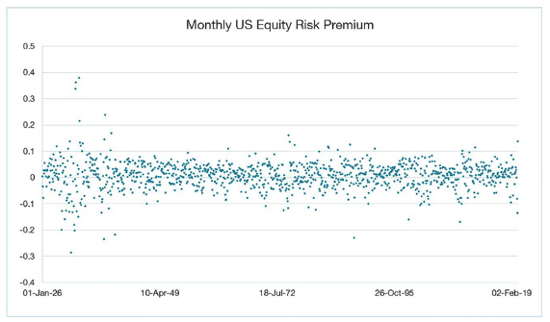
The monthly US equity premium has been remarkably consistent, within a range, throughout history. It has an arithmetic average of 0.65%, and it has been positive 60% of the time. There tend to be periods, visible in Figure 2, where the monthly premium becomes more volatile; volatility clustering is a well-known phenomenon. Over periods longer than one month we also observe characteristic negative skewness - frequent small gains and a few extreme losses.
Â
Given the nature of stock returns, we would expect a stock investor to achieve positive returns with roughly the same frequency as the equity risk premium being positive. For the remainder of this paper, we will be comparing lump sum investing to dollar-cost averaging in terms of absolute returns, as opposed to observing their risk premiums. US stock returns have been positive in absolute terms 63% of the time in the historical data.

For most markets, and on average across markets, we find that roughly two-thirds of the time LSI beats DCA over 10-year periods in terms of ending assets. The exception is Japan which is unsurprising given its unique long-term stock market outcome; Japan’s equity market has trailed One-Month US Treasury Bills since 1990.
Â
Table 2 – LSI vs. DCA for 10-Year Historical Periods
Â

Â
Data source: Dimensional Returns Web, CRSP, MSCI, S&P Dow Jones Indices, PWL Capital Inc.
Â
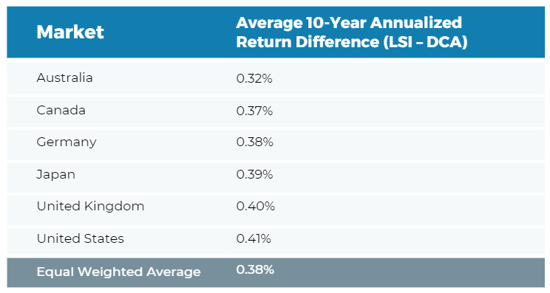
The basic insight that we draw from this result is that, on average, LSI leads to greater ending wealth than DCA. To quantify the extent to which LSI tends to beat DCA we examined the 10-year annualized performance difference for the full sample. An annualized figure stated as a percentage makes for an easy comparison to familiar items like fees and withholding taxes. On average, DCA is leaving a meaningful amount of expected returns on the table at 0.38% annualized over ten years in the historical data; this should not be a surprise considering that DCA delays exposure to higher expected returning stocks.
Â
Table 3 – LSI vs. DCA Annualized 10-Year Performance Difference
Â
Â
Â
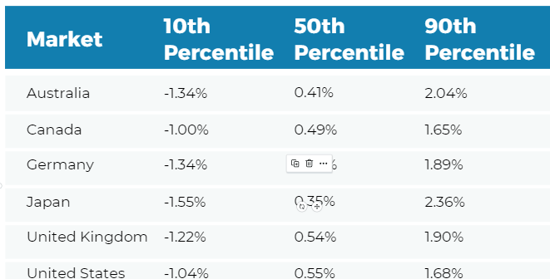
Comparing average outcomes is interesting but it does not speak to the dispersion of outcomes. Even if DCA is worse on average in terms of expected average outcomes, maybe it offers some protection on the downside. To assess this, we calculate the difference in annualized returns for LSI and DCA over 10-year periods and sort the data into percentiles. The 10th percentile is the bottom 10% of outcomes, the 50th percentile is the median, and the 90th percentile is the top 10%.
Â
Table 4 – Difference in Annualized Returns (LSI – DCA)
Â
Â
Data source:Â Dimensional Returns Web, CRSP, MSCI, S&P Dow Jones Indices, PWL Capital Inc.
Â
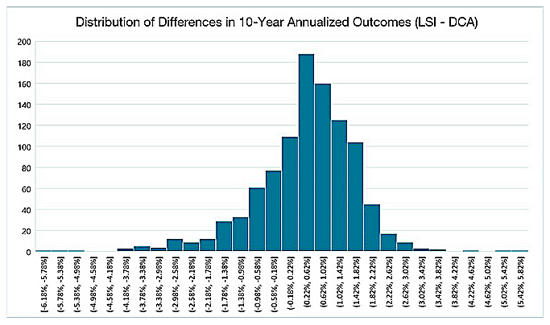
It should be clear from Table 4 that LSI is beating DCA by a healthy margin on average. In the best 10% of outcomes (90th percentile), more has been gained by LSI over DCA than what has been lost in the worst 10% of outcomes. The median outcome is positive, and the distribution is negatively skewed. None of this should be a surprise considering the positive expected risk premium of stocks over treasury bills, and the left-skewed distribution of stock returns. Figure 3 shows the shape of the distribution of the differences in outcomes for LSI less DCA in terms of 10-year annualized returns.
Â
Figure 3 – Distribution of Differences in 10-Year Annualized Outcomes (LSI - DCA)
Â
Â
Data source:Â Dimensional Returns Web, CRSP, MSCI, S&P Dow Jones Indices, PWL Capital Inc.
Â
At the most extreme, the far left and right tails of the distribution, LSI does look worse than DCA. This observation is consistent with a negatively skewed distribution; we see that most of the outcomes are good, but the worst outcomes are more extreme than the best outcomes. This validates the idea that DCA might be able to offer protection from the worst outcomes, but it comes at a significant cost in terms of expected returns.

Â
Table 5 – LSI vs. DCA in the 10th Percentile LSI Historical Periods
Â

Â
Data source:Â Dimensional Returns Web, CRSP, MSCI, S&P Dow Jones Indices, PWL Capital Inc.
Â
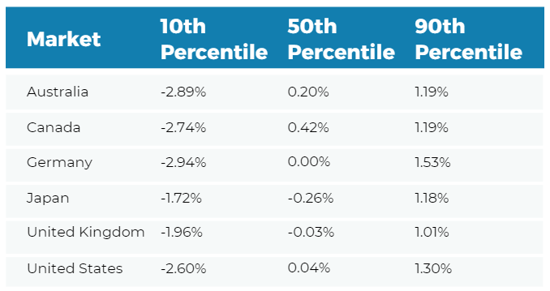
In half of our markets, LSI still beats DCA most of the time even when LSI has delivered its worst historical outcomes; this is also true with an equal-weighted average of all markets in the sample. The results are not as strongly in favor of LSI as the full data series but remember that we have intentionally selected the worst LSI outcomes for this sample. While the number of outcomes is evenly matched, the bad outcomes in this case are worse in magnitude than the good ones. The result is a negative difference in annualized 10-year performance. This should not be surprising considering our intentional selection of the worst LSI outcomes in the sample.
Â
Table 6 – Difference in Annualized Returns for 10th Percentile LSI Outcomes (LSI – DCA)
Â
Â
Data source:Â Dimensional Returns Web, CRSP, MSCI, S&P Dow Jones Indices, PWL Capital Inc.
Â
Even under artificial conditions of a known bad future outcome for LSI, DCA offers less than a 50% shot at an improvement. DCA does however offer an edge when the magnitude of positive and negative outcomes is considered – despite the roughly even split between good and bad outcomes, the bad outcomes are worse than the good outcomes are good. This seems to give credence to the mythical ability of DCA to improve an extremely bad LSI outcome. An important nuance in the data is that the worst LSI outcomes relative to other LSI outcomes do not correspond with the worst LSI outcomes relative to DCA outcomes. The most extreme instances of underperformance for LSI relative to DCA have less to do with the LSI outcome being extremely bad and more to do with the DCA outcome being extremely good. In other words, lucky timing for DCA, as opposed to avoiding unlucky timing for LSI, drives the difference in the most extreme cases.
Â
Given that it is impossible to predict which time periods will result in the worst outcomes for a lump sum investment, we next turn to two signals commonly believed to offer forward-looking insight into future investment returns.

Â

Â
Data source:Â Dimensional Returns Web, CRSP, MSCI, S&P Dow Jones Indices, PWL Capital Inc.
Â
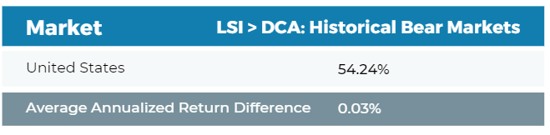
We again find that LSI produces a better outcome than DCA most of the time in most countries in the sample. Nestle employees and retirees should note that the US experience is significantly impacted by the enormous volatility and seemingly perpetual market drops in the 1930s. We find that, on average, LSI beats DCA by a 10-year annualized 0.25% when the investment period begins with the month after a drop of 20% or more has occurred. Echoing the experience of the full data series we also see that there has historically been more to gain from LSI in the 90th percentile of outcomes than there has been to lose in the 10th percentile. DCA is not offering protection from bad outcomes without also exposing us to a greater risk of missing good outcomes.
Â
Table 8 – Difference in Annualized Returns Starting at Bear Markets (LSI – DCA)
Â

Â
Data source:Â Dimensional Returns Web, CRSP, MSCI, S&P Dow Jones Indices, PWL Capital Inc.
Â
It's important for Nestle employees to keep in mind that our trigger to begin the investment period is a 20% drop. In some cases, a 20% drop is followed by more drops, while in other cases it is followed by a rebound. Based on the data in Tables 7 and 8 we can see that rebounds are more impactful, on average than further drops. This results in LSI delivering a better result than DCA most of the time, even during periods of market volatility.

Â
Â
Data source:Â Dimensional Returns Web, CRSP, Barclays Research, PWL Capital Inc.
Â
While it may seem concerning, this observation suffers from a massive bias: at any point in time we do not have the full set of past and future Shiller CAPE data to base a decision - we only have past data in our possession. We adjust for this by measuring the market’s expensiveness only relative to historical data for each data point. For example, for January 1926 we are comparing the Shiller CAPE to the set of data from February 1872 to January 1926, not from February 1872 to May 2026 to test for expansiveness. In this case, LSI beats DCA 63.70% of the time.
Â
Table 10 – LSI vs. DCA when Stock Prices are High Relative to Backward-looking History
Â

This exercise is to remind Nestle employees and retirees that while valuations may look high at a point in time, they can always get higher. Japan might be a particularly interesting case study on the usefulness of market valuations in making the LSI vs. DCA decision. We have less data for Japan, so instead of comparing historical Japanese data, we will compare Japanese valuations to US data to determine expensiveness. The highest level of the monthly Shiller CAPE for the full US historical data series is 44.19 which occurred in December 1999. Japan exceeded this level in May 1986 with a Shiller CAPE of 44.31. While the Japanese market did eventually crash in 1990, there are 29 monthly observations following May 1986 where LSI beats DCA by a wide margin. Even starting in November 1988, with a Shiller CAPE of 72.07, LSI beats DCA in Japan in terms of 10-year annualized returns.
Â
It is well-known that future returns tend to be relatively low when valuations are relatively high. Despite this, using valuation as a signal to time the LSI vs. DCA decision has historically resulted in unfavorable outcomes most of the time.

Â
If DCA seems like a solution to avoiding pain when investing new money, we think that it is a reasonable strategy. However, we also think that if the fear of loss is so great that DCA needs to be employed to make an asset allocation decision palatable, that asset allocation may be too aggressive. It should feel comfortable to invest a lump sum in a risk-appropriate portfolio. We do not want to imply that DCA should never be employed, but we do believe that if it feels necessary to use DCA in order to implement an asset allocation decision, it may be wise to revisit the portfolio altogether.


Therefore, we encourage you to have your plan updated a few months before your potential retirement date as well as an annual review. It should be emphasized that neither The Retirement Group, LLC nor any of its employees can engage in the practice of law or accounting and that nothing in this document should be taken as an effort to do so. We look forward to working with tax and/or legal professionals you may select to discuss the relevant ramifications of our recommendations.
Throughout your retirement years we will continue to update you on issues affecting your retirement through our complimentary and proprietary newsletters, workshops and regular updates. You may always reach us at (800) 900-5867.

What is the primary purpose of Nestlé's 401(k) Savings Plan?
The primary purpose of Nestlé's 401(k) Savings Plan is to help employees save for retirement by allowing them to contribute a portion of their salary to a tax-advantaged account.
How can employees enroll in Nestlé's 401(k) Savings Plan?
Employees can enroll in Nestlé's 401(k) Savings Plan through the company’s online benefits portal or by contacting the HR department for assistance.
Does Nestlé match employee contributions to the 401(k) Savings Plan?
Yes, Nestlé offers a matching contribution to the 401(k) Savings Plan, which helps employees maximize their retirement savings.
What is the maximum contribution limit for Nestlé's 401(k) Savings Plan?
The maximum contribution limit for Nestlé's 401(k) Savings Plan is determined by the IRS and may change annually; employees should check the latest guidelines for the current limit.
Can employees of Nestlé choose how their 401(k) contributions are invested?
Yes, employees of Nestlé can choose from a variety of investment options within the 401(k) Savings Plan to align with their retirement goals and risk tolerance.
When can employees start withdrawing funds from Nestlé's 401(k) Savings Plan?
Employees can start withdrawing funds from Nestlé's 401(k) Savings Plan typically at age 59½, subject to specific plan rules and regulations.
What happens to an employee's 401(k) account if they leave Nestlé?
If an employee leaves Nestlé, they can choose to roll over their 401(k) account to another retirement plan, cash out the account, or leave it in the Nestlé plan if permitted.
Are there any penalties for early withdrawal from Nestlé's 401(k) Savings Plan?
Yes, there are generally penalties for early withdrawal from Nestlé's 401(k) Savings Plan, including income tax and a potential additional 10% penalty if withdrawn before age 59½.
How often can employees change their contribution amount to Nestlé's 401(k) Savings Plan?
Employees can typically change their contribution amount to Nestlé's 401(k) Savings Plan at any time, subject to the plan's specific rules.
Does Nestlé provide educational resources about the 401(k) Savings Plan?
Yes, Nestlé provides educational resources and workshops to help employees understand their 401(k) Savings Plan options and make informed decisions.

For more information you can reach the plan administrator for Nestle at 30 ivan allen jr. blvd Atlanta, GA 30308; or by calling them at 404-506-5000.
https://www.nestle.com/documents/pension-plan-2022.pdf - Page 5, https://www.nestle.com/documents/pension-plan-2023.pdf - Page 12, https://www.nestle.com/documents/pension-plan-2024.pdf - Page 15, https://www.nestle.com/documents/401k-plan-2022.pdf - Page 8, https://www.nestle.com/documents/401k-plan-2023.pdf - Page 22, https://www.nestle.com/documents/401k-plan-2024.pdf - Page 28, https://www.nestle.com/documents/rsu-plan-2022.pdf - Page 20, https://www.nestle.com/documents/rsu-plan-2023.pdf - Page 14, https://www.nestle.com/documents/rsu-plan-2024.pdf - Page 17, https://www.nestle.com/documents/healthcare-plan-2022.pdf - Page 23
Help shape our next stories
Choose the topics you’d love to read more about. Your input helps us focus on content that matters to you.