New Update: Rising Oil Costs are Affecting Retirement Plans. Will you be impacted?
High Inflation: How Long Will It Last for Kroger Employees?



Barron’s: Awarded on 9/12/2025 (Mega RIA) for 6/30/24-6/30/25. Paid for logo use. Forbes: Awarded 10/1/25 for 3/31/24-3/31/25. Paid for logo use. USA Today: Awarded 4/15/26 for the five-year period ending January 2026. Paid for logo use.

Oil market turbulence continues to ripple through the broader economy, with crude swinging between $50 and $120 per barrel and annualized volatility near 80%. Refrigerated distribution networks and petroleum-based packaging costs mean grocery retailers face direct margin pressure from sustained crude price increases. For Kroger employees focused on long-term financial health, periods of oil-driven economic volatility reinforce the value of diversified strategies that account for how energy markets influence the broader investment landscape. Professional guidance can help you navigate the indirect effects of oil volatility on your retirement planning and ensure your strategy accounts for these dynamics.
In March 2026, the Consumer Price Index for All Urban Consumers (CPI-U), the most common measure of inflation, rose at an annual rate of 8.5%, the highest level since December 1981.
1
 It's not surprising that a Gallup poll at the end of March found that one out of six Americans considers inflation to be the most important problem facing the United States.
2Â
When inflation began rising in the spring of 2026, many economists, including policymakers at the Federal Reserve, believed the increase would be transitory and subside over a period of months. One year later, inflation has proven to be more stubborn than expected. It may be helpful for Kroger employees and retirees to look at some of the forces behind rising prices, the Fed's plan to combat them, and early signs that inflation may be easing.
Â
Hot Economy Meets Russia and China
The fundamental cause of rising inflation continues to be the growing pains of a rapidly opening economy — a combination of pent-up consumer demand, supply-chain slowdowns, and not enough workers to fill open jobs. Loose Federal Reserve monetary policies and billions of dollars in government stimulus helped prevent a deeper recession but added fuel to the fire when the economy reopened.
Â
More recently, the Russian invasion of Ukraine has placed upward pressure on already high global fuel and food prices.
3
 At the same time, a COVID resurgence in China led to strict lockdowns that have closed factories and tightened already struggling supply chains for Chinese goods. The volume of cargo handled by the port of Shanghai, the world's busiest port, dropped by an estimated 40% in early April.
4
Behind the Headlines
Although the 8.5% year-over-year 'headline' inflation in March is a daunting number for our Kroger clients to consider, monthly numbers provide a clearer picture of the current trend. The month-over-month increase of 1.2% was extremely high, but more than half of it was due to gasoline prices, which rose 18.3% in March alone. 5  Despite the Russia-Ukraine conflict and increased seasonal demand, U.S. gas prices dropped in April, but the trend was moving upward by the end of the month. 6  The federal government's decision to release one million barrels of oil per day from the Strategic Petroleum Reserve for the next six months and allow summer sales of higher-ethanol gasoline may help moderate prices. 7
Â
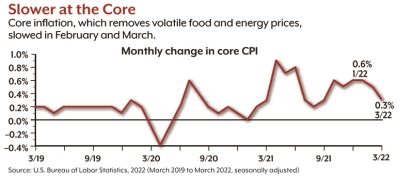
Core inflation, which strips out volatile food and energy prices, rose 6.5% year-over-year in March, the highest rate since 1982. However, it's important that our Kroger clients consider that the month-over-month increase from February to March was just 0.3%, the slowest pace in six months. Another positive sign was the price of used cars and trucks, which rose more than 35% over the last 12 months (a prime driver of general inflation) but dropped 3.8% in March.
8
Wages and Consumer Demand
In March, average hourly earnings increased by 5.6% — but not enough to keep up with inflation and blunt the effects that impacted a variety of businesses, as well as many Kroger employees and retirees around the country. Lower-paid service workers received higher increases, with wages jumping by almost 15% for non-management employees in the leisure and hospitality industry. Although inflation has cut deeply into wage gains over the last year, wages have increased at about the same rate as inflation over the two-year period of the post-pandemic era. 9
One of the big questions going forward is whether rising wages will enable consumers to continue to pay higher prices, which can lead to an inflationary spiral of ever-increasing wages and prices. Recent signals are mixed. The official measure of consumer spending increased 1.1% in March, but an early April poll found that two out of three Americans had cut back on spending due to inflation.
10-11
Soft or Hard Landing?
The current inflationary situation has raised many questions among our Kroger clients in regard to what the solution is. The Federal Open Market Committee (FOMC) of the Federal Reserve has laid out a plan to fight inflation by raising interest rates and tightening the money supply. After dropping the benchmark federal funds rate to near zero in order to stimulate the economy at the onset of the post-pandemic era, the FOMC raised the rate by 0.25% at its March 2026 meeting and projected the equivalent of six more quarter-percent increases by the end of the year and three or four more in 2026.
12
 This would bring the rate to around 2.75%, just above what the FOMC considers a 'neutral rate' that will neither stimulate nor restrain the economy.
13
Before finalizing any estate plan, it is worth examining how Kroger's employer-sponsored benefits fit into the broader picture. According to publicly available information, Kroger maintains an active defined benefit pension plan, which provides retirement income based on factors such as years of service and compensation history. Kroger also offers retiree healthcare benefits to eligible employees, which can provide meaningful coverage for those who retire before reaching Medicare eligibility at age 65. Because the specifics of your pension formula, vesting schedule, and benefit eligibility depend on your individual employment history and plan documents, We encourage you to review your Summary Plan Description (SPD) or speak with Kroger's HR or benefits team for the most current details.
These moves were projected to bring the Fed's preferred measure of inflation, the Personal Consumption Expenditures (PCE) Price Index, down to 4.3% by the end of 2026, 2.7% by the end of 2026, and 2.3% by the end of 2026.
14
 PCE inflation — which was 6.6% in March — tends to run below CPI, so even if the Fed achieves these goals, CPI inflation will likely remain somewhat higher.
15
Fed policymakers have signaled a willingness to be more aggressive, if necessary, and the FOMC raised the fund's rate by 0.5% at its May meeting, as opposed to the more common 0.25% increase. This was the first half-percent increase since May 2000, and there may be more to come. The FOMC also began reducing the Fed's bond holdings to tighten the money supply. New projections to be released in June will provide an updated picture of the Fed's intentions for the federal funds rate.
16
The question facing the FOMC is how fast it can raise interest rates and tighten the money supply while maintaining optimal employment and economic growth. The ideal is a 'soft landing,' similar to what occurred in the 1990s, when inflation was tamed without damaging the economy. At the other extreme is the 'hard landing' of the early 1980s, when the Fed raised the fund's rate to almost 20% in order to control runaway double-digit inflation, throwing the economy into a recession. 18
Fed Chair Jerome Powell acknowledges that a soft landing will be difficult to achieve, but he believes the strong job market may help the economy withstand aggressive monetary policies. Supply chains are expected to improve over time, and workers who have not yet returned to the labor force might fill open jobs without increasing wage and price pressures. 19
The next few months will be a key period to reveal the future direction of inflation and monetary policy, and we recommend that Kroger employees and retirees keep this topic in mind. The hope is that March represented the peak and inflation will begin to trend downward. But even if that proves to be true, it could be a painfully slow descent.
We'd like to remind our clients from Kroger that projections are based on current conditions, are subject to change, and may not come to pass.
1, 5, 8-9) U.S. Bureau of Labor Statistics, 2026
2) Gallup, March 29, 2026
3, 7) The New York Times, April 12, 2026
4) CNBC, April 7, 2026
6) AAA, April 25 & 29, 2026
10, 15) U.S. Bureau of Economic Analysis, 2026
11) CBS News, April 11, 2026
12, 14, 16) Federal Reserve, 2026
13, 17) The Wall Street Journal, April 18, 2026
18) The New York Times, March 21, 2026
How does the KROGER CONSOLIDATED RETIREMENT BENEFIT PLAN ensure that employees receive adequate retirement benefits calculated based on their years of service and compensation? Are there specific formulas or formulas that KROGER uses to ensure fair distribution of benefits among its participants, particularly in regards to early retirement adjustments?
The KROGER CONSOLIDATED RETIREMENT BENEFIT PLAN ensures that employees receive adequate retirement benefits based on a formula that takes into account both years of credited service and compensation. The plan, being a defined benefit plan, calculates benefits that are typically paid out monthly upon reaching the normal retirement age, but adjustments can be made for early retirement. This formula guarantees that employees who retire early will see reductions based on the plan’s terms, ensuring a fair distribution across participants(KROGER_2023-10-01_QDRO_…).
In what ways does the cash balance formula mentioned in the KROGER CONSOLIDATED RETIREMENT BENEFIT PLAN impact the retirement planning of employees? How are these benefits expressed in more relatable terms similar to a defined contribution plan, and how might this affect an employee's perception of their retirement savings?
The cash balance formula in the KROGER CONSOLIDATED RETIREMENT BENEFIT PLAN impacts retirement planning by expressing benefits in a manner similar to defined contribution plans. Instead of a traditional annuity calculation, the benefits are often framed as a hypothetical account balance or lump sum, which might make it easier for employees to relate their retirement savings to more familiar terms, thereby influencing how they perceive the growth and adequacy of their retirement savings(KROGER_2023-10-01_QDRO_…).
Can you explain the concept of "shared payment" and "separate interest" as they apply to the KROGER CONSOLIDATED RETIREMENT BENEFIT PLAN? How do these payment structures affect retirees and their alternate payees, and what considerations should participants keep in mind when navigating these options?
In the KROGER CONSOLIDATED RETIREMENT BENEFIT PLAN, "shared payment" refers to a payment structure where the alternate payee receives a portion of the participant’s benefit during the participant's lifetime. In contrast, "separate interest" means that the alternate payee receives a separate benefit, typically over their own lifetime. These structures impact how retirees and their alternate payees manage their retirement income, with shared payments being tied to the participant’s life and separate interests providing independent payments(KROGER_2023-10-01_QDRO_…).
What procedures does KROGER have in place for employees to access or review the applicable Summary Plan Description? How can understanding this document help employees make more informed decisions regarding their retirement benefits and entitlements under the KROGER plan?
KROGER provides procedures for employees to access the Summary Plan Description, typically through HR or digital platforms. Understanding this document is crucial as it outlines the plan’s specific terms, helping employees make more informed decisions about retirement benefits, including when to retire and how to maximize their benefits under the plan(KROGER_2023-10-01_QDRO_…).
With regard to early retirement options, what specific features of the KROGER CONSOLIDATED RETIREMENT BENEFIT PLAN can employees take advantage of? How does the plan's definition of "normal retirement age" influence an employee's decision to retire early, and what potential consequences might this have on their benefits?
The KROGER CONSOLIDATED RETIREMENT BENEFIT PLAN offers early retirement options that include adjustments for those retiring before the plan’s defined "normal retirement age." This early retirement can result in reduced benefits, so employees must carefully consider how retiring early will impact their overall retirement income. The definition of normal retirement age serves as a benchmark, influencing the timing of retirement decisions(KROGER_2023-10-01_QDRO_…).
How does the KROGER CONSOLIDATED RETIREMENT BENEFIT PLAN address potential changes in federal regulations or tax law that may impact retirement plans? In what ways does KROGER communicate these changes to employees, and how can participants stay informed about updates to their retirement benefits?
The KROGER CONSOLIDATED RETIREMENT BENEFIT PLAN incorporates changes in federal regulations or tax laws by updating the plan terms accordingly. KROGER communicates these changes to employees through official channels, such as newsletters or HR communications, ensuring participants are informed and can adjust their retirement planning in line with regulatory changes(KROGER_2023-10-01_QDRO_…).
What are some common misconceptions regarding participation in the KROGER CONSOLIDATED RETIREMENT BENEFIT PLAN that employees might have? How can these misconceptions impact their retirement planning strategies, and what resources does KROGER provide to clarify these issues?
A common misconception regarding participation in the KROGER CONSOLIDATED RETIREMENT BENEFIT PLAN is that it functions similarly to a defined contribution plan, which it does not. This can lead to confusion about benefit accrual and payouts. KROGER provides resources such as plan summaries and HR support to clarify these misunderstandings and help employees better strategize their retirement plans(KROGER_2023-10-01_QDRO_…).
How does the KROGER CONSOLIDATED RETIREMENT BENEFIT PLAN interact with other employer-sponsored retirement plans, specifically concerning offsetting benefits? What implications does this have for employees who may also be participating in defined contribution plans?
The KROGER CONSOLIDATED RETIREMENT BENEFIT PLAN interacts with other employer-sponsored retirement plans by offsetting benefits, particularly with defined contribution plans. This means that benefits from the defined benefit plan may be reduced if the employee is also receiving benefits from a defined contribution plan, impacting the total retirement income(KROGER_2023-10-01_QDRO_…).
What options are available to employees of KROGER regarding the distribution of their retirement benefits upon reaching retirement age? How can employees effectively plan their retirement income to ensure sustainability through their retirement years based on the features of the KROGER plan?
Upon reaching retirement age, KROGER employees have various options for distributing their retirement benefits, including lump sums or annuity payments. Employees should carefully plan their retirement income, considering the sustainability of their benefits through their retirement years. The plan’s features provide flexibility, allowing employees to choose the option that best fits their financial goals(KROGER_2023-10-01_QDRO_…).
How can employees contact KROGER for more information or assistance regarding the KROGER CONSOLIDATED RETIREMENT BENEFIT PLAN? What are the recommended channels for employees seeking guidance on their retirement benefits, and what type of support can they expect from KROGER's human resources team?
Employees seeking more information or assistance regarding the KROGER CONSOLIDATED RETIREMENT BENEFIT PLAN can contact the company through HR or dedicated plan administrators. The recommended channels include direct communication with HR or online resources. Employees can expect detailed support in understanding their benefits and planning for retirement(KROGER_2023-10-01_QDRO_…).

For more information you can reach the plan administrator for Kroger at 104 vine street Cincinnati, OH 45202-1100; or by calling them at 513-762-4000.
https://www.thekrogerco.com/documents/pension-plan-2022.pdf - Page 5, https://www.thekrogerco.com/documents/pension-plan-2023.pdf - Page 12, https://www.thekrogerco.com/documents/pension-plan-2024.pdf - Page 15, https://www.thekrogerco.com/documents/401k-plan-2022.pdf - Page 8, https://www.thekrogerco.com/documents/401k-plan-2023.pdf - Page 22, https://www.thekrogerco.com/documents/401k-plan-2024.pdf - Page 28, https://www.thekrogerco.com/documents/rsu-plan-2022.pdf - Page 20, https://www.thekrogerco.com/documents/rsu-plan-2023.pdf - Page 14, https://www.thekrogerco.com/documents/rsu-plan-2024.pdf - Page 17, https://www.thekrogerco.com/documents/healthcare-plan-2022.pdf - Page 23
Help shape our next stories
Choose the topics you’d love to read more about. Your input helps us focus on content that matters to you.