New Update: Rising Oil Costs are Affecting Retirement Plans. Will you be impacted?
High Inflation: How Long Will It Last for University of California Employees?



Barron’s: Awarded on 9/12/2025 (Mega RIA) for 6/30/24-6/30/25. Paid for logo use. Forbes: Awarded 10/1/25 for 3/31/24-3/31/25. Paid for logo use. USA Today: Awarded 4/15/26 for the five-year period ending January 2026. Paid for logo use.

Energy market instability persists, with crude prices fluctuating between $50 and $120 per barrel and annualized volatility running around 80%. The effects reach well beyond the energy sector. When crude oil prices remain volatile, the effects cascade through supply chains, consumer prices, and financial markets in ways that reach every industry. University of California employees may not think of themselves as exposed to oil markets, but energy-driven inflation, rate movements, and index fund performance create indirect connections to their financial planning. Comprehensive financial planning at University of California benefits from understanding how energy price volatility creates indirect effects on inflation, interest rates, and portfolio valuations that affect long-term wealth building. A financial advisor can help you build strategies that maintain progress toward retirement goals through periods of energy-driven economic turbulence.
In March 2026, the Consumer Price Index for All Urban Consumers (CPI-U), the most common measure of inflation, rose at an annual rate of 8.5%, the highest level since December 1981.
1
 It's not surprising that a Gallup poll at the end of March found that one out of six Americans considers inflation to be the most important problem facing the United States.
2Â
When inflation began rising in the spring of 2026, many economists, including policymakers at the Federal Reserve, believed the increase would be transitory and subside over a period of months. One year later, inflation has proven to be more stubborn than expected. It may be helpful for University of California employees and retirees to look at some of the forces behind rising prices, the Fed's plan to combat them, and early signs that inflation may be easing.
Â
Hot Economy Meets Russia and China
The fundamental cause of rising inflation continues to be the growing pains of a rapidly opening economy — a combination of pent-up consumer demand, supply-chain slowdowns, and not enough workers to fill open jobs. Loose Federal Reserve monetary policies and billions of dollars in government stimulus helped prevent a deeper recession but added fuel to the fire when the economy reopened.
Â
More recently, the Russian invasion of Ukraine has placed upward pressure on already high global fuel and food prices.
3
 At the same time, a COVID resurgence in China led to strict lockdowns that have closed factories and tightened already struggling supply chains for Chinese goods. The volume of cargo handled by the port of Shanghai, the world's busiest port, dropped by an estimated 40% in early April.
4
Behind the Headlines
Although the 8.5% year-over-year 'headline' inflation in March is a daunting number for our University of California clients to consider, monthly numbers provide a clearer picture of the current trend. The month-over-month increase of 1.2% was extremely high, but more than half of it was due to gasoline prices, which rose 18.3% in March alone. 5  Despite the Russia-Ukraine conflict and increased seasonal demand, U.S. gas prices dropped in April, but the trend was moving upward by the end of the month. 6  The federal government's decision to release one million barrels of oil per day from the Strategic Petroleum Reserve for the next six months and allow summer sales of higher-ethanol gasoline may help moderate prices. 7
Â
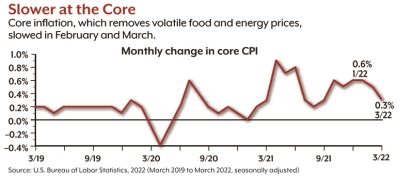
Core inflation, which strips out volatile food and energy prices, rose 6.5% year-over-year in March, the highest rate since 1982. However, it's important that our University of California clients consider that the month-over-month increase from February to March was just 0.3%, the slowest pace in six months. Another positive sign was the price of used cars and trucks, which rose more than 35% over the last 12 months (a prime driver of general inflation) but dropped 3.8% in March.
8
Wages and Consumer Demand
In March, average hourly earnings increased by 5.6% — but not enough to keep up with inflation and blunt the effects that impacted a variety of businesses, as well as many University of California employees and retirees around the country. Lower-paid service workers received higher increases, with wages jumping by almost 15% for non-management employees in the leisure and hospitality industry. Although inflation has cut deeply into wage gains over the last year, wages have increased at about the same rate as inflation over the two-year period of the post-pandemic era. 9
One of the big questions going forward is whether rising wages will enable consumers to continue to pay higher prices, which can lead to an inflationary spiral of ever-increasing wages and prices. Recent signals are mixed. The official measure of consumer spending increased 1.1% in March, but an early April poll found that two out of three Americans had cut back on spending due to inflation.
10-11
Soft or Hard Landing?
The current inflationary situation has raised many questions among our University of California clients in regard to what the solution is. The Federal Open Market Committee (FOMC) of the Federal Reserve has laid out a plan to fight inflation by raising interest rates and tightening the money supply. After dropping the benchmark federal funds rate to near zero in order to stimulate the economy at the onset of the post-pandemic era, the FOMC raised the rate by 0.25% at its March 2026 meeting and projected the equivalent of six more quarter-percent increases by the end of the year and three or four more in 2026.
12
 This would bring the rate to around 2.75%, just above what the FOMC considers a 'neutral rate' that will neither stimulate nor restrain the economy.
13
Before finalizing any estate plan, it is worth examining how University of California's employer-sponsored benefits fit into the broader picture. According to publicly available information, University of California does not maintain a traditional defined benefit pension plan, making your 401(k) plan and personal savings the primary vehicles for retirement income. University of California does not appear to offer a formal retiree healthcare program, so healthcare coverage planning before Medicare eligibility at age 65 is an important consideration. We encourage you to review your Summary Plan Description (SPD) or speak with University of California's HR or benefits team for the most current details.
These moves were projected to bring the Fed's preferred measure of inflation, the Personal Consumption Expenditures (PCE) Price Index, down to 4.3% by the end of 2026, 2.7% by the end of 2026, and 2.3% by the end of 2026.
14
 PCE inflation — which was 6.6% in March — tends to run below CPI, so even if the Fed achieves these goals, CPI inflation will likely remain somewhat higher.
15
Fed policymakers have signaled a willingness to be more aggressive, if necessary, and the FOMC raised the fund's rate by 0.5% at its May meeting, as opposed to the more common 0.25% increase. This was the first half-percent increase since May 2000, and there may be more to come. The FOMC also began reducing the Fed's bond holdings to tighten the money supply. New projections to be released in June will provide an updated picture of the Fed's intentions for the federal funds rate.
16
The question facing the FOMC is how fast it can raise interest rates and tighten the money supply while maintaining optimal employment and economic growth. The ideal is a 'soft landing,' similar to what occurred in the 1990s, when inflation was tamed without damaging the economy. At the other extreme is the 'hard landing' of the early 1980s, when the Fed raised the fund's rate to almost 20% in order to control runaway double-digit inflation, throwing the economy into a recession. 18
Fed Chair Jerome Powell acknowledges that a soft landing will be difficult to achieve, but he believes the strong job market may help the economy withstand aggressive monetary policies. Supply chains are expected to improve over time, and workers who have not yet returned to the labor force might fill open jobs without increasing wage and price pressures. 19
The next few months will be a key period to reveal the future direction of inflation and monetary policy, and we recommend that University of California employees and retirees keep this topic in mind. The hope is that March represented the peak and inflation will begin to trend downward. But even if that proves to be true, it could be a painfully slow descent.
We'd like to remind our clients from University of California that projections are based on current conditions, are subject to change, and may not come to pass.
1, 5, 8-9) U.S. Bureau of Labor Statistics, 2026
2) Gallup, March 29, 2026
3, 7) The New York Times, April 12, 2026
4) CNBC, April 7, 2026
6) AAA, April 25 & 29, 2026
10, 15) U.S. Bureau of Economic Analysis, 2026
11) CBS News, April 11, 2026
12, 14, 16) Federal Reserve, 2026
13, 17) The Wall Street Journal, April 18, 2026
18) The New York Times, March 21, 2026
How does the University of California Retirement Plan (UCRP) define service credit for members, and how does it impact retirement benefits? In what ways can University of California employees potentially enhance their service credit, thereby influencing their retirement income upon leaving the University of California?
Service Credit in UCRP: Service credit is essential in determining retirement eligibility and the amount of retirement benefits for University of California employees. It is based on the period of employment in an eligible position and covered compensation during that time. Employees earn service credit proportionate to their work time, and unused sick leave can convert to additional service credit upon retirement. Employees can enhance their service credit through methods like purchasing service credit for unpaid leaves or sabbatical periods(University of Californi…).
Regarding the contribution limits for the University of California’s defined contribution plans, how do these limits for 2024 compare to previous years, and what implications do they have for current employees of the University of California in their retirement planning strategies? How can understanding these limits lead University of California employees to make more informed decisions about their retirement savings?
Contribution Limits for UC Defined Contribution Plans in 2024: Contribution limits for defined contribution plans, such as the University of California's DC Plan, often adjust yearly due to IRS regulations. Increases in these limits allow employees to maximize their retirement savings. For 2024, employees can compare the current limits with previous years to understand how much they can contribute tax-deferred, potentially increasing their long-term savings and tax advantages(University of Californi…).
What are the eligibility criteria for the various death benefits associated with the University of California Retirement Plan? Specifically, how does being married or in a domestic partnership influence the eligibility of beneficiaries for University of California employees' retirement and survivor benefits?
Eligibility for UCRP Death Benefits: Death benefits under UCRP depend on factors like length of service, eligibility to retire, and marital or domestic partnership status. Being married or in a registered domestic partnership allows a spouse or partner to receive survivor benefits, which might include lifetime income. In some cases, other beneficiaries like children or dependent parents may be eligible(University of Californi…).
In the context of retirement planning for University of California employees, what are the tax implications associated with rolling over benefits from their defined benefit plan to an individual retirement account (IRA)? How do these rules differ depending on whether the employee chooses a direct rollover or receives a distribution first before rolling it over into an IRA?
Tax Implications of Rolling Over UCRP Benefits: Rolling over benefits from UCRP to an IRA can offer tax advantages. A direct rollover avoids immediate taxes, while receiving a distribution first and rolling it into an IRA later may result in withholding and potential penalties. UC employees should consult tax professionals to ensure they follow the IRS rules that suit their financial goals(University of Californi…).
What are the different payment options available to University of California retirees when selecting their retirement income, and how does choosing a contingent annuitant affect their monthly benefit amount? What factors should University of California employees consider when deciding on the best payment option for their individual financial situations?
Retirement Payment Options: UC retirees can choose from various payment options, including a single life annuity or joint life annuity with a contingent annuitant. Selecting a contingent annuitant reduces the retiree's monthly income but provides benefits for another person after their death. Factors like age, life expectancy, and financial needs should guide this decision(University of Californi…).
What steps must University of California employees take to prepare for retirement regarding their defined contribution accounts, and how can they efficiently consolidate their benefits? In what ways does the process of managing multiple accounts influence the overall financial health of employees during their retirement?
Preparation for Retirement: UC employees nearing retirement must evaluate their defined contribution accounts and consider consolidating their benefits for easier management. Properly managing multiple accounts ensures they can maximize their income and minimize fees, thus contributing to their financial health during retirement(University of Californi…).
How do the rules around capital accumulation payments (CAP) impact University of California employees, and what choices do they have regarding their payment structures upon retirement? What considerations might encourage a University of California employee to opt for a lump-sum cashout versus a traditional monthly pension distribution?
Capital Accumulation Payments (CAP): CAP is a supplemental benefit that certain UCRP members receive upon leaving the University. UC employees can choose between a lump sum cashout or a traditional monthly pension. Those considering a lump sum might prefer immediate access to funds, but the traditional option offers ongoing, stable income(University of Californi…)(University of Californi…).
As a University of California employee planning for retirement, what resources are available for understanding and navigating the complexities of the retirement benefits offered? How can University of California employees make use of online platforms or contact university representatives for personalized assistance regarding their retirement plans?
Resources for UC Employees' Retirement Planning: UC offers extensive online resources, such as UCnet and UCRAYS, where employees can manage their retirement plans. Personalized assistance is also available through local benefits offices and the UC Retirement Administration Service Center(University of Californi…).
What unique challenges do University of California employees face with regard to healthcare and retirement planning, particularly in terms of post-retirement health benefits? How do these benefits compare to other state retirement systems, and what should employees of the University of California be aware of when planning for their medical expenses after retirement?
Healthcare and Retirement Planning Challenges: Post-retirement healthcare benefits are crucial for UC employees, especially as healthcare costs rise. UC’s retirement health benefits offer significant support, often more comprehensive than other state systems. However, employees should still prepare for potential gaps and rising costs in their post-retirement planning(University of Californi…).
How can University of California employees initiate contact to learn more about their retirement benefits, and what specific information should they request when reaching out? What methods of communication are recommended for efficient resolution of inquiries related to their retirement plans within the University of California system?
Contacting UC for Retirement Information: UC employees can contact the UC Retirement Administration Service Center for assistance with retirement benefits. It is recommended to request information on service credits, pension benefits, and health benefits. Communication via the UCRAYS platform ensures secure and efficient resolution of inquiries(University of Californi…).

For more information you can reach the plan administrator for University of California at 9500 gilman dr La Jolla, CA 92093; or by calling them at 858-534-2230.
https://www.ucop.edu/ucpath-center/_files/2022-benefits-fair/2022-summary-benefits.pdf - Page 5, https://www.ucop.edu/ucpath-center/_files/2023-benefits-fair/2023-summary-benefits.pdf - Page 12, https://www.ucop.edu/ucpath-center/_files/2024-benefits-fair/2024-summary-benefits.pdf - Page 15, https://www.ucop.edu/ucpath-center/_files/401k-plan-2022.pdf - Page 8, https://www.ucop.edu/ucpath-center/_files/401k-plan-2023.pdf - Page 22, https://www.ucop.edu/ucpath-center/_files/401k-plan-2024.pdf - Page 28, https://www.ucop.edu/ucpath-center/_files/rsu-plan-2022.pdf - Page 20, https://www.ucop.edu/ucpath-center/_files/rsu-plan-2023.pdf - Page 14, https://www.ucop.edu/ucpath-center/_files/rsu-plan-2024.pdf - Page 17, https://www.ucop.edu/ucpath-center/_files/healthcare-plan-2022.pdf - Page 23
Help shape our next stories
Choose the topics you’d love to read more about. Your input helps us focus on content that matters to you.