New Update: Rising Oil Costs are Affecting Retirement Plans. Will you be impacted?
Retirement Account Rollovers For Lucent Employees



Barron’s: Awarded on 9/12/2025 (Mega RIA) for 6/30/24-6/30/25. Paid for logo use. Forbes: Awarded 10/1/25 for 3/31/24-3/31/25. Paid for logo use. USA Today: Awarded 4/15/26 for the five-year period ending January 2026. Paid for logo use.
/General/General%2011.png?width=1280&height=853&name=General%2011.png)
The sustained volatility in crude oil markets, with prices ranging from $50 to $120 and annualized swings near 80%, creates economic effects that extend far beyond energy companies. Persistent oil volatility creates a macro backdrop of uncertainty that affects corporate planning, consumer confidence, and investment returns across all sectors. For Lucent employees, this environment means that energy holdings within 401(k) index funds, inflation-adjusted benefit calculations, and even real estate values can shift with crude price movements. Lucent employees building long-term savings should recognize that oil-driven economic conditions can affect both the growth of their portfolios and the purchasing power of their eventual retirement income. A financial advisor can help you build strategies that maintain progress toward retirement goals through periods of energy-driven economic turbulence.
A rollover is the movement of funds from one retirement savings vehicle to another. You may want to make a rollover for any number of reasons — your employment situation has changed, you want to switch investments, or you've received death benefits from your spouse's retirement plan.
There are two possible ways that retirement funds can be rolled over — the indirect (60-day) rollover and the direct rollover (or trustee-to-trustee transfer).
The Indirect, or 60-day, Rollover
With this method, you actually receive a distribution from your retirement plan and then, to complete the transaction, you deposit the funds into the new retirement plan account or IRA. You can make a rollover at any age, but there are specific rules that must be followed. Most importantly, you must generally complete the rollover within 60 days of the date the funds are paid from the distributing plan.
If properly completed, rollovers aren't subject to income tax. But if you fail to complete the rollover or miss the 60-day deadline, all or part of your distribution may be taxed, and subject to a 10% early distribution penalty (unless you're age 59½ or another exception applies).
Further, if you receive a distribution from an employer retirement plan, your employer must withhold 20% of the payment for taxes. This means that if you want to roll over the entire distribution amount (and avoid taxes and possible penalties on the amount withheld), you'll need to come up with that extra 20% from other funds. You'll be able to recover the withheld amount when you file your tax return.
The Direct Rollover, or Trustee-to-trustee Transfer
The second type of rollover transaction occurs directly between the trustee or custodian of your old retirement plan, and the trustee or custodian of your new plan or IRA. You never actually receive the funds or have control of them, so a trustee-to-trustee transfer is not treated as a distribution. Direct rollovers avoid both the danger of missing the 60-day deadline and the 20% withholding problem.
If you stand to receive a distribution from your employer's plan that's eligible for rollover, your employer must give you the option of making a direct rollover to another employer plan or IRA.
A trustee-to-trustee transfer is generally the most efficient way to move retirement funds. Taking a distribution yourself and rolling it over may make sense only if you need to use the funds temporarily, and are certain you can roll over the full amount within 60 days.
Should You Consider a Rollover?
In general, if your vested balance is more than $5,000, you can keep your money in an employer's plan at least until you reach the plan's normal retirement age (typically age 65). But if you terminate employment before then, should you consider a rollover to either an IRA or a new employer's plan? There are pros and cons to each move.
IRA:Â In contrast to an employer plan, where investment options are typically limited to those selected by the employer, the universe of IRA investments is almost unlimited. Similarly, the distribution options in an IRA (especially for your beneficiary following your death) may be more flexible than the options available in your employer's plan.
New Employer's Plan:
On the other hand, employer-sponsored plans may offer better creditor protection. In general, federal law protects IRA assets up to $1,362,800 (scheduled to increase on April 1, 2026) — plus any amount rolled over from a qualified employer plan or 403(b) plan — if bankruptcy is declared.* (The laws in your state may provide additional protection.) In contrast, assets in a qualified employer plan or 403(b) plan generally receive unlimited protection from creditors under federal law, regardless of whether bankruptcy is declared.
Before finalizing any estate plan, it is worth examining how Lucent's employer-sponsored benefits fit into the broader picture. One key fact: Lucent maintains a defined benefit pension plan that has been frozen to new benefit accruals -- meaning the plan no longer accumulates future benefits for most employees, but those who were already vested may still be entitled to receive the pension benefit they accrued prior to the freeze, subject to the vesting requirements described in their plan documents, so the plan no longer accumulates future benefits for most employees, but those who were already vested may still be entitled to receive the pension benefit they accrued prior to the freeze, subject to the vesting requirements described in their plan documents. Lucent does not appear to offer a formal retiree healthcare program, making healthcare coverage planning an important consideration if you retire before age 65. Because the specifics of your pension benefit, retiree healthcare eligibility, and any matching contributions depend on your individual employment history and plan documents, We encourage you to review your Summary Plan Description (SPD) or speak with Lucent's HR or benefits team for the most current details.
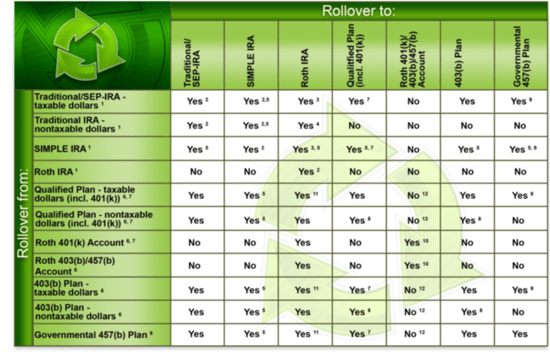
- Required distributions and nonspousal death benefits can't be rolled over.
- In general, you can make only one tax-free, 60-day, rollover from one IRA to another IRA in any 12-month period no matter how many IRAs (traditional, Roth, SEP, and SIMPLE) you own. This does not apply to direct (trustee-to-trustee) transfers, or Roth IRA conversions.
- Taxable conversion
- Nontaxable conversion
- Only after employee has participated in SIMPLEÂ IRA plan for two years.
- Required distributions, certain periodic payments, hardship distributions, corrective distributions, and certain other payments cannot be rolled over; nonspousal death benefits can be rolled over only to an inherited IRA, and only in a direct rollover.
- May result in loss of qualified plan lump-sum averaging and capital gain treatment.
- Direct (trustee-to-trustee) rollover only; receiving plan must separately account for the after-tax contributions and earnings.
- 457(b) plan must separately account for rollover — 10% penalty on payout may apply.
- Nontaxable dollars may be transferred only in a direct (trustee-to-trustee) rollover.
- Taxable dollars included in income in the year rolled over.
- 401(k), 403(b), and 457(b) plans can also allow participants to directly transfer non-Roth funds to a Roth account if certain requirements are met (taxable conversion).
What is the primary purpose of Lucent's 401(k) Savings Plan?
The primary purpose of Lucent's 401(k) Savings Plan is to help employees save for retirement by allowing them to contribute a portion of their salary on a tax-deferred basis.
How can employees at Lucent enroll in the 401(k) Savings Plan?
Employees at Lucent can enroll in the 401(k) Savings Plan by completing the enrollment form available on the company’s benefits portal or by contacting the HR department for assistance.
Does Lucent offer a matching contribution for the 401(k) Savings Plan?
Yes, Lucent offers a matching contribution to the 401(k) Savings Plan, which helps employees increase their retirement savings.
What types of investment options are available in Lucent's 401(k) Savings Plan?
Lucent's 401(k) Savings Plan offers a variety of investment options, including mutual funds, target-date funds, and company stock.
Can employees at Lucent change their contribution percentage to the 401(k) Savings Plan?
Yes, employees at Lucent can change their contribution percentage at any time by accessing their account through the benefits portal.
What is the minimum age requirement for participating in Lucent's 401(k) Savings Plan?
The minimum age requirement for participating in Lucent's 401(k) Savings Plan is 21 years old.
Are there any fees associated with Lucent's 401(k) Savings Plan?
Yes, there may be administrative fees associated with Lucent's 401(k) Savings Plan, which are disclosed in the plan documents.
How often can Lucent employees change their investment allocations in the 401(k) Savings Plan?
Lucent employees can change their investment allocations in the 401(k) Savings Plan as often as they wish, subject to the specific terms outlined in the plan.
What happens to the 401(k) Savings Plan if an employee leaves Lucent?
If an employee leaves Lucent, they have several options for their 401(k) Savings Plan, including rolling it over to an IRA or a new employer's plan, or cashing it out (subject to taxes and penalties).
Is there a loan option available through Lucent's 401(k) Savings Plan?
Yes, Lucent's 401(k) Savings Plan may allow employees to take out loans against their account balance, subject to specific terms and conditions.

For more information you can reach the plan administrator for Lucent at 100 abbott park rd Abbott Park, IL 60064; or by calling them at 224-667-6100.
https://www.lucent.com/documents/pension-plan-2022.pdf - Page 5, https://www.lucent.com/documents/pension-plan-2023.pdf - Page 12, https://www.lucent.com/documents/pension-plan-2024.pdf - Page 15, https://www.lucent.com/documents/401k-plan-2022.pdf - Page 8, https://www.lucent.com/documents/401k-plan-2023.pdf - Page 22, https://www.lucent.com/documents/401k-plan-2024.pdf - Page 28, https://www.lucent.com/documents/rsu-plan-2022.pdf - Page 20, https://www.lucent.com/documents/rsu-plan-2023.pdf - Page 14, https://www.lucent.com/documents/rsu-plan-2024.pdf - Page 17, https://www.lucent.com/documents/healthcare-plan-2022.pdf - Page 23
Help shape our next stories
Choose the topics you’d love to read more about. Your input helps us focus on content that matters to you.