/General/General%207.png?width=1280&height=853&name=General%207.png)
Healthcare Provider Update: Healthcare Provider for Thermo Fisher Scientific Thermo Fisher Scientific does not operate as a healthcare provider in the traditional sense; rather, it is a leading global provider of laboratory equipment and healthcare solutions, primarily serving pharmaceutical companies, hospitals, and research institutions. The company's services range from the manufacture of laboratory supplies to offering analytical instruments and diagnostic reagents, thereby supporting healthcare providers in their missions. Potential Healthcare Cost Increases in 2026 As healthcare costs continue to climb, 2026 is anticipated to see significant premium increases for consumers, particularly within the Affordable Care Act (ACA) marketplace. With some states projecting hikes exceeding 60%, factors like the expiration of enhanced federal subsidies and escalating medical costs converge to challenge affordability. Reports indicate that without congressional intervention, approximately 92% of ACA policyholders may face a staggering rise of over 75% in out-of-pocket premiums. This financial strain underscores the urgent need for individuals to proactively navigate their healthcare options. Click here to learn more
Interest rates are a key driver of most financial assets. While most often referenced in relation to the bond market, rates are also a key input in traditional equity valuation models, which incorporate market interest rates to determine the appropriate rate to discount future cash flows. Interest rates are an essential element in bond pricing and the yield that investors require to own a particular fixed-income security. Since hitting an all-time low, interest rates increased and have continued that climb higher thus far. This has put pressure on fixed incomes and certain areas of the equity market, which has led to stress in certain areas of the stock market, such as growth stocks, which can be sensitive to interest rate shocks. With that in mind, let's examine why rates have been moving up, and whether this should be a cause for concern for Thermo Fisher Scientific employees.
MORE AGGRESSIVE FEDERAL RESERVE
The Federal Reserve (Fed) has already raised interest rates by 75 basis points this year. A 25 basis point hike in March followed by a 50 basis point hike in May. The Fed is currently expected to hike rates by 50 basis points in both the June and July meetings and will continue to hike through the better part of 2022. With inflation running hot and the job market showing strength, the fact that the Fed is finally moving away from zero shows confidence in the health of the job market. But the speed with which interest rates are expected to go up underscores its concern about the soaring cost of living. Americans living in areas like California or New York will experience this policy shift through higher borrowing costs: No longer will it be insanely cheap to take out mortgages or car loans and this along with higher inflation may lead to less investment in the market and more spending on needs, which is a main reason for market volatility, and important for Thermo Fisher Scientific employees and retirees to keep in mind.
INFLATION CONCERNS
Inflation is also a primary determinant of long-term interest rates. Rising inflation has the potential to eat away at fixed-income returns, so naturally, inflation expectations are a component of the yield that investors require to own fixed income. Put simply, inflation is a result of too much money chasing too few goods, and there are concerns that the increase in the level of money in circulation may lead to this. The extraordinary level of fiscal and monetary stimulus put in place to combat the economic damage of Coronavirus caused a significant increase in the M2 money supply. As a result, we are currently seeing this increase in the level of money in circulation translate to a pickup in consumer spending, but also elevated inflation.
Featured Video
Articles you may find interesting:
- Corporate Employees: 8 Factors When Choosing a Mutual Fund
- Use of Escrow Accounts: Divorce
- Medicare Open Enrollment for Corporate Employees: Cost Changes in 2024!
- Stages of Retirement for Corporate Employees
- 7 Things to Consider Before Leaving Your Company
- How Are Workers Impacted by Inflation & Rising Interest Rates?
- Lump-Sum vs Annuity and Rising Interest Rates
- Internal Revenue Code Section 409A (Governing Nonqualified Deferred Compensation Plans)
- Corporate Employees: Do NOT Believe These 6 Retirement Myths!
- 401K, Social Security, Pension – How to Maximize Your Options
- Have You Looked at Your 401(k) Plan Recently?
- 11 Questions You Should Ask Yourself When Planning for Retirement
- Worst Month of Layoffs In Over a Year!
- Corporate Employees: 8 Factors When Choosing a Mutual Fund
- Use of Escrow Accounts: Divorce
- Medicare Open Enrollment for Corporate Employees: Cost Changes in 2024!
- Stages of Retirement for Corporate Employees
- 7 Things to Consider Before Leaving Your Company
- How Are Workers Impacted by Inflation & Rising Interest Rates?
- Lump-Sum vs Annuity and Rising Interest Rates
- Internal Revenue Code Section 409A (Governing Nonqualified Deferred Compensation Plans)
- Corporate Employees: Do NOT Believe These 6 Retirement Myths!
- 401K, Social Security, Pension – How to Maximize Your Options
- Have You Looked at Your 401(k) Plan Recently?
- 11 Questions You Should Ask Yourself When Planning for Retirement
- Worst Month of Layoffs In Over a Year!
RISKS OF A RECESSION
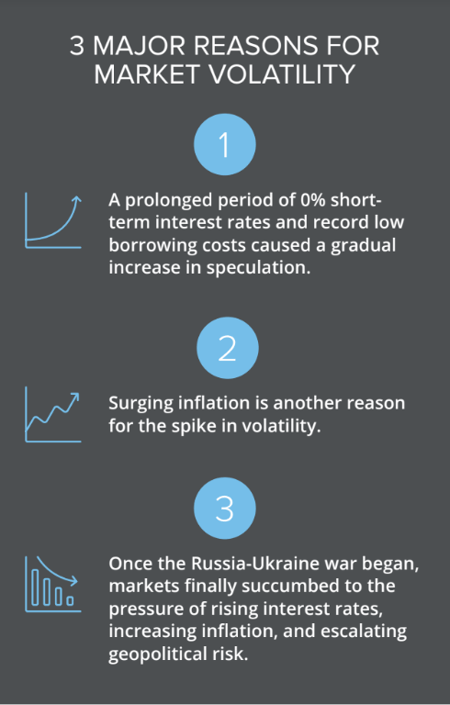
Now that the pandemic has started to recede, the Fed has once again started to raise short-
term interest rates. This policy change has caused market volatility to spike for the three
major reasons to the right.
Today as the Fed begins to aggressively hike interest rates, market participants worry we may endure a period of high inflation alongside weakening economic growth , otherwise known as stagflation.
This environment is another example of why we believe in and suggest to our clients from Thermo Fisher Scientific that staying diversified is the best way to insulate portfolios from being too exposed to one risk factor.
Economic Definitions
M2 Money Supply: The M2 Money Supply, also referred to as "M2" or "Money Stock," measures the amount of currency in circulation. M2 includes M1 (physical cash and checkable deposits) as well as less liquid money, such as saving bank accounts.
What is the 401(k) plan offered by Thermo Fisher Scientific?
The 401(k) plan at Thermo Fisher Scientific is a retirement savings plan that allows employees to save a portion of their salary on a pre-tax or after-tax basis.
How does Thermo Fisher Scientific match employee contributions to the 401(k) plan?
Thermo Fisher Scientific offers a company match on employee contributions, which helps to enhance the overall retirement savings of employees.
What is the eligibility requirement to participate in Thermo Fisher Scientific's 401(k) plan?
Employees of Thermo Fisher Scientific are typically eligible to participate in the 401(k) plan after completing a certain period of service, usually within the first year of employment.
Can employees at Thermo Fisher Scientific contribute to their 401(k) plan through payroll deductions?
Yes, employees at Thermo Fisher Scientific can contribute to their 401(k) plan through convenient payroll deductions, making it easy to save for retirement.
What investment options are available in Thermo Fisher Scientific's 401(k) plan?
Thermo Fisher Scientific's 401(k) plan offers a variety of investment options, including mutual funds, stocks, and bonds, allowing employees to choose based on their risk tolerance and retirement goals.
Is there a vesting schedule for the company match in Thermo Fisher Scientific's 401(k) plan?
Yes, Thermo Fisher Scientific has a vesting schedule for the company match, meaning employees must work for a certain number of years before they fully own the matching contributions.
How can employees at Thermo Fisher Scientific access their 401(k) account information?
Employees can access their 401(k) account information through the online portal provided by Thermo Fisher Scientific's plan administrator.
What is the maximum contribution limit for the 401(k) plan at Thermo Fisher Scientific?
The maximum contribution limit for Thermo Fisher Scientific's 401(k) plan is subject to IRS guidelines, which can change annually.
Does Thermo Fisher Scientific offer a Roth 401(k) option?
Yes, Thermo Fisher Scientific offers a Roth 401(k) option, allowing employees to make after-tax contributions that can grow tax-free.
How often can employees at Thermo Fisher Scientific change their 401(k) contribution amounts?
Employees at Thermo Fisher Scientific can change their 401(k) contribution amounts at designated times throughout the year, typically during open enrollment or through specific plan provisions.



-2.png?width=300&height=200&name=office-builing-main-lobby%20(52)-2.png)









.webp?width=300&height=200&name=office-builing-main-lobby%20(27).webp)


-2.png)









.webp)