/General/General%205.png?width=1280&height=853&name=General%205.png)
Healthcare Provider Update: Healthcare Provider for EnLink Midstream: EnLink Midstream primarily collaborates with health insurance providers to manage employee health benefits; however, specific healthcare providers associated with EnLink Midstream aren't publicly detailed in available resources. Potential Healthcare Cost Increases for EnLink Midstream in 2026: As we look towards 2026, EnLink Midstream could face significant increases in healthcare costs driven by a perfect storm of economic factors. Affordability concerns are amplified by anticipated record hikes in ACA premiums, with some states seeing increases over 60%. The potential expiration of enhanced federal premium subsidies may push out-of-pocket expenses for employees, causing premiums to rise by over 75% for many. This combination of escalating medical costs and regulatory changes could strain both company resources and employee health benefits, necessitating strategic adjustments in how EnLink approaches healthcare coverage. Click here to learn more
With EnLink Midstream shares up approximately significantly over the past 90 days amid unprecedented global energy market disruptions, estate planning — including strategies to transfer appreciated assets efficiently — has become a critical priority for many employees.
Oil prices have climbed sharply in March 2026, with Brent reaching ~$107/barrel and WTI near ~$94/barrel, as geopolitical escalation in the Middle East has dramatically curtailed tanker traffic through the Strait of Hormuz.
The disruption extends beyond crude: Henry Hub natural gas is near ~$2.94/MMBtu and European TTF is near ~$16.90/MMBtu as the conflict has effectively shut down a major LNG export hub in the Persian Gulf.
Estate planning for EnLink Midstream employees in Q1 2026 may benefit from reviewing irrevocable trust structures, GRATs, or other vehicles designed to transfer appreciating energy sector assets in a tax-efficient manner before prices potentially normalize.
In March 2022, the Consumer Price Index for All Urban Consumers (CPI-U), the most common measure of inflation, rose at an annual rate of 8.5%, the highest level since December 1981.
1
It's not surprising that a Gallup poll at the end of March found that one out of six Americans considers inflation to be the most important problem facing the United States.
2
When inflation began rising in the spring of 2021, many economists, including policymakers at the Federal Reserve, believed the increase would be transitory and subside over a period of months. The inflation surge ultimately proved more stubborn than expected. It is helpful to understand the forces behind those rising prices, the Fed's response to combat them, and how the situation ultimately resolved.
Hot Economy Meets Russia and China
The fundamental cause of rising inflation continues to be the growing pains of a rapidly opening economy — a combination of pent-up consumer demand, supply-chain slowdowns, and not enough workers to fill open jobs. Loose Federal Reserve monetary policies and billions of dollars in government stimulus helped prevent a deeper recession but added fuel to the fire when the economy reopened.
The Russian invasion of Ukraine placed additional upward pressure on already high global fuel and food prices.
3
At the same time, a COVID resurgence in China led to strict lockdowns that closed factories and tightened already struggling supply chains for Chinese goods. The volume of cargo handled by the port of Shanghai, the world's busiest port, dropped by an estimated 40% in early April.
4
Behind the Headlines
Although the 8.5% year-over-year 'headline' inflation in March 2022 was a striking number for clients to consider at the time, monthly numbers provided a clearer picture of the trend. The month-over-month increase of 1.2% was extremely high, but more than half of it was due to gasoline prices, which rose 18.3% in March alone.
5
Despite the Russia-Ukraine conflict and increased seasonal demand, U.S. gas prices dropped in April, but the trend was moving upward by the end of the month.
6
The federal government's decision to release one million barrels of oil per day from the Strategic Petroleum Reserve for the next six months and allow summer sales of higher-ethanol gasoline may help moderate prices.
7
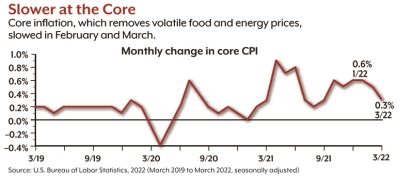
Core inflation, which strips out volatile food and energy prices, rose 6.5% year-over-year in March, the highest rate since 1982. However, it's important that our EnLink Midstream clients consider that the month-over-month increase from February to March was just 0.3%, the slowest pace in six months. Another positive sign was the price of used cars and trucks, which rose more than 35% over the last 12 months (a prime driver of general inflation) but dropped 3.8% in March.
8
Articles you may find interesting:
- Corporate Employees: 8 Factors When Choosing a Mutual Fund
- Use of Escrow Accounts: Divorce
- Medicare Open Enrollment for Corporate Employees: Cost Changes in 2024!
- Stages of Retirement for Corporate Employees
- 7 Things to Consider Before Leaving Your Company
- How Are Workers Impacted by Inflation & Rising Interest Rates?
- Lump-Sum vs Annuity and Rising Interest Rates
- Internal Revenue Code Section 409A (Governing Nonqualified Deferred Compensation Plans)
- Corporate Employees: Do NOT Believe These 6 Retirement Myths!
- 401K, Social Security, Pension – How to Maximize Your Options
- Have You Looked at Your 401(k) Plan Recently?
- 11 Questions You Should Ask Yourself When Planning for Retirement
- Worst Month of Layoffs In Over a Year!
- Corporate Employees: 8 Factors When Choosing a Mutual Fund
- Use of Escrow Accounts: Divorce
- Medicare Open Enrollment for Corporate Employees: Cost Changes in 2024!
- Stages of Retirement for Corporate Employees
- 7 Things to Consider Before Leaving Your Company
- How Are Workers Impacted by Inflation & Rising Interest Rates?
- Lump-Sum vs Annuity and Rising Interest Rates
- Internal Revenue Code Section 409A (Governing Nonqualified Deferred Compensation Plans)
- Corporate Employees: Do NOT Believe These 6 Retirement Myths!
- 401K, Social Security, Pension – How to Maximize Your Options
- Have You Looked at Your 401(k) Plan Recently?
- 11 Questions You Should Ask Yourself When Planning for Retirement
- Worst Month of Layoffs In Over a Year!
Wages and Consumer Demand
In March, average hourly earnings increased by 5.6% — but not enough to keep up with inflation and blunt the effects that impacted a variety of businesses, as well as many EnLink Midstream employees and retirees around the country. Lower-paid service workers received higher increases, with wages jumping by almost 15% for non-management employees in the leisure and hospitality industry. Although inflation cut deeply into wage gains over the prior year, wages have increased at about the same rate as inflation over the two-year period of the pandemic.
9
One of the central questions at the time was whether rising wages would enable consumers to continue to pay higher prices, which can lead to an inflationary spiral of ever-increasing wages and prices. Signals were mixed: consumer spending rose 1.1% in March 2022, but an early April 2022 poll found that two out of three Americans had already cut back on spending due to inflation.
10-11
Soft or Hard Landing?
The inflationary situation raised many questions about the path forward. The Federal Open Market Committee (FOMC) of the Federal Reserve laid out a plan to fight inflation by raising interest rates and tightening the money supply. After dropping the benchmark federal funds rate to near zero to stimulate the economy at the onset of the pandemic, the FOMC raised the rate by 0.25% at its March 2022 meeting and projected the equivalent of six more quarter-percent increases by the end of 2022 and three or four more in 2023.
12
That path was projected to bring the rate to around 2.75%, just above what the FOMC considered a 'neutral rate' that would neither stimulate nor restrain the economy.
13
Those rate increases successfully brought the Fed's preferred measure of inflation, the Personal Consumption Expenditures (PCE) Price Index, down toward the Fed's 2% target -- a gradual disinflation that played out through 2023 and 2024.
14
PCE inflation -- which had reached 6.6% in March 2022 -- tends to run below CPI; as the Fed's tightening took hold, both measures declined meaningfully through 2023 and 2024.
15
The FOMC went on to raise the fund's rate by 0.5% at its May 2022 meeting -- the first half-percent increase since May 2000 -- and continued hiking aggressively through 2022 and into 2023. The FOMC also reduced the Fed's bond holdings to tighten the money supply.
16
The question facing the FOMC is how fast it can raise interest rates and tighten the money supply while maintaining optimal employment and economic growth. The ideal is a 'soft landing,' similar to what occurred in the 1990s, when inflation was tamed without damaging the economy. At the other extreme is the 'hard landing' of the early 1980s, when the Fed raised the fund's rate to almost 20% in order to control runaway double-digit inflation, throwing the economy into a recession. 18
Fed Chair Jerome Powell acknowledges that a soft landing will be difficult to achieve, but he believes the strong job market may help the economy withstand aggressive monetary policies. Supply chains are expected to improve over time, and workers who have not yet returned to the labor force might fill open jobs without increasing wage and price pressures. 19
March 2022 did in fact represent the peak of that inflationary surge. Inflation trended lower through 2023 and 2024, though the descent was gradual. Employees and retirees are encouraged to revisit their financial plans in light of the current interest rate environment.
We'd like to remind our clients from EnLink Midstream that projections are based on current conditions, are subject to change, and may not come to pass.
1, 5, 8-9) U.S. Bureau of Labor Statistics, 2022
2) Gallup, March 29, 2022
3, 7) The New York Times, April 12, 2022
4) CNBC, April 7, 2022
6) AAA, April 25 & 29, 2022
10, 15) U.S. Bureau of Economic Analysis, 2022
11) CBS News, April 11, 2022
12, 14, 16) Federal Reserve, 2022
13, 17) The Wall Street Journal, April 18, 2022
18) The New York Times, March 21, 2022
What is the primary purpose of the 401(k) plan at EnLink Midstream?
The primary purpose of the 401(k) plan at EnLink Midstream is to help employees save for retirement by allowing them to contribute a portion of their salary on a pre-tax basis.
How can employees enroll in the 401(k) plan at EnLink Midstream?
Employees can enroll in the 401(k) plan at EnLink Midstream by accessing the enrollment portal through the company's HR website or by contacting the HR department for assistance.
Does EnLink Midstream offer a company match for 401(k) contributions?
Yes, EnLink Midstream offers a company match for employee contributions to the 401(k) plan, which helps employees increase their retirement savings.
What types of investment options are available in EnLink Midstream's 401(k) plan?
EnLink Midstream's 401(k) plan offers a variety of investment options, including mutual funds, target-date funds, and other investment vehicles to suit different risk tolerances.
When can employees start contributing to the 401(k) plan at EnLink Midstream?
Employees at EnLink Midstream can start contributing to the 401(k) plan after they have completed their eligibility requirements, typically within their first few months of employment.
What is the maximum contribution limit for the 401(k) plan at EnLink Midstream?
The maximum contribution limit for the 401(k) plan at EnLink Midstream follows the IRS guidelines, which may change annually. Employees should check the current limits for the specific year.
Can employees take loans against their 401(k) balance at EnLink Midstream?
Yes, EnLink Midstream allows employees to take loans against their 401(k) balance, subject to the plan's terms and conditions.
What happens to an employee's 401(k) balance if they leave EnLink Midstream?
If an employee leaves EnLink Midstream, they can choose to roll over their 401(k) balance to another retirement account, cash it out (which may incur penalties), or leave it in the EnLink Midstream plan if allowed.
Is there a vesting schedule for the company match in EnLink Midstream's 401(k) plan?
Yes, EnLink Midstream has a vesting schedule for the company match, meaning employees must work for a certain period before they fully own the matched contributions.
How often can employees change their contribution amounts in EnLink Midstream's 401(k) plan?
Employees at EnLink Midstream can typically change their contribution amounts at any time, subject to the plan's guidelines.



-2.png?width=300&height=200&name=office-builing-main-lobby%20(52)-2.png)









.webp?width=300&height=200&name=office-builing-main-lobby%20(27).webp)


-2.png)









.webp)