New Update: Rising Oil Costs are Affecting Retirement Plans. Will you be impacted?
Understanding the Impact of High Inflation: Insights for McDonald's Employees and Retirees



Barron’s: Awarded on 9/12/2025 (Mega RIA) for 6/30/24-6/30/25. Paid for logo use. Forbes: Awarded 10/1/25 for 3/31/24-3/31/25. Paid for logo use. USA Today: Awarded 4/15/26 for the five-year period ending January 2026. Paid for logo use.

Oil prices between $50 and $120 per barrel with 80% annualized volatility have created ripple effects throughout the economy over the past six months. Facility energy costs and travel demand suppression from high fuel prices create direct and indirect headwinds for hospitality companies. Retirement savings strategies at McDonald's should account for how energy price cycles influence inflation, interest rates, and market returns over the long horizons that retirement planning requires. A financial advisor can help you build strategies that maintain progress toward retirement goals through periods of energy-driven economic turbulence.
In March 2022, the Consumer Price Index for All Urban Consumers (CPI-U), the most common measure of inflation, rose at an annual rate of 8.5%, the highest level since December 1981.
1
It's not surprising that a Gallup poll at the end of March found that one out of six Americans considers inflation to be the most important problem facing the United States.
2
When inflation began rising in the spring of 2021, many economists, including policymakers at the Federal Reserve, believed the increase would be transitory and subside over a period of months. The inflation surge ultimately proved more stubborn than expected. It is helpful to understand the forces behind those rising prices, the Fed's response to combat them, and how the situation ultimately resolved.
Hot Economy Meets Russia and China
The fundamental cause of rising inflation continues to be the growing pains of a rapidly opening economy — a combination of pent-up consumer demand, supply-chain slowdowns, and not enough workers to fill open jobs. Loose Federal Reserve monetary policies and billions of dollars in government stimulus helped prevent a deeper recession but added fuel to the fire when the economy reopened.
The Russian invasion of Ukraine placed additional upward pressure on already high global fuel and food prices.
3
At the same time, a COVID resurgence in China led to strict lockdowns that closed factories and tightened already struggling supply chains for Chinese goods. The volume of cargo handled by the port of Shanghai, the world's busiest port, dropped by an estimated 40% in early April.
4
Behind the Headlines
Although the 8.5% year-over-year 'headline' inflation in March 2022 was a striking number for clients to consider at the time, monthly numbers provided a clearer picture of the trend. The month-over-month increase of 1.2% was extremely high, but more than half of it was due to gasoline prices, which rose 18.3% in March alone. 5 Despite the Russia-Ukraine conflict and increased seasonal demand, U.S. gas prices dropped in April, but the trend was moving upward by the end of the month. 6 The federal government's decision to release one million barrels of oil per day from the Strategic Petroleum Reserve for the next six months and allow summer sales of higher-ethanol gasoline may help moderate prices. 7
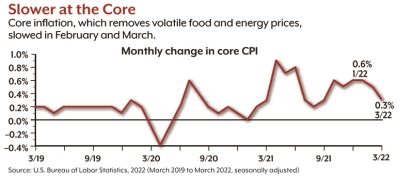
Core inflation, which strips out volatile food and energy prices, rose 6.5% year-over-year in March, the highest rate since 1982. However, it's important that our McDonald's clients consider that the month-over-month increase from February to March was just 0.3%, the slowest pace in six months. Another positive sign was the price of used cars and trucks, which rose more than 35% over the last 12 months (a prime driver of general inflation) but dropped 3.8% in March.
8
Wages and Consumer Demand
In March, average hourly earnings increased by 5.6% — but not enough to keep up with inflation and blunt the effects that impacted a variety of businesses, as well as many McDonald's employees and retirees around the country. Lower-paid service workers received higher increases, with wages jumping by almost 15% for non-management employees in the leisure and hospitality industry. Although inflation cut deeply into wage gains over the prior year, wages have increased at about the same rate as inflation over the two-year period of the pandemic. 9
One of the central questions at the time was whether rising wages would enable consumers to continue to pay higher prices, which can lead to an inflationary spiral of ever-increasing wages and prices. Signals were mixed: consumer spending rose 1.1% in March 2022, but an early April 2022 poll found that two out of three Americans had already cut back on spending due to inflation.
10-11
Soft or Hard Landing?
The inflationary situation raised many questions about the path forward. The Federal Open Market Committee (FOMC) of the Federal Reserve laid out a plan to fight inflation by raising interest rates and tightening the money supply. After dropping the benchmark federal funds rate to near zero to stimulate the economy at the onset of the pandemic, the FOMC raised the rate by 0.25% at its March 2022 meeting and projected the equivalent of six more quarter-percent increases by the end of 2022 and three or four more in 2023.
12
That path was projected to bring the rate to around 2.75%, just above what the FOMC considered a 'neutral rate' that would neither stimulate nor restrain the economy.
13
That same shift from growing assets to drawing them down applies directly to the pension decisions in front of you at McDonald's. McDonald's maintains an active defined benefit pension plan, meaning eligible employees continue to accrue benefits based on years of service and compensation. If you are eligible for a lump sum payout, IRS Section 417(e) segment rates determine how the future annuity stream converts to a present-value payment - rising rates compress the lump sum, so monitoring the plan's stability period and lookback month is critical before you lock in your election date. The choice between a single-life annuity, a joint-and-survivor option, or a lump sum (where available) is generally irrevocable once made, and timing that decision relative to interest rate conditions can meaningfully affect your retirement income picture.
On the healthcare side, McDonald's does not offer continued medical coverage to retirees, which means coverage through the company ends when employment does. Planning for the cost of health insurance during any gap between your retirement date and Medicare eligibility at age 65 is a critical step - marketplace coverage, COBRA continuation, or a spouse's employer plan are common options. Building an accurate estimate of bridge-coverage costs into your retirement income projection prevents underestimating one of the largest variable expenses retirees face. Connecting your specific McDonald's benefits situation to a comprehensive retirement income plan - and understanding how each component interacts - gives you the most complete picture of what retirement will look like.
Those rate increases successfully brought the Fed's preferred measure of inflation, the Personal Consumption Expenditures (PCE) Price Index, down toward the Fed's 2% target -- a gradual disinflation that played out through 2023 and 2024.
14
PCE inflation -- which had reached 6.6% in March 2022 -- tends to run below CPI; as the Fed's tightening took hold, both measures declined meaningfully through 2023 and 2024.
15
The FOMC went on to raise the fund's rate by 0.5% at its May 2022 meeting -- the first half-percent increase since May 2000 -- and continued hiking aggressively through 2022 and into 2023. The FOMC also reduced the Fed's bond holdings to tighten the money supply.
16
The question facing the FOMC is how fast it can raise interest rates and tighten the money supply while maintaining optimal employment and economic growth. The ideal is a 'soft landing,' similar to what occurred in the 1990s, when inflation was tamed without damaging the economy. At the other extreme is the 'hard landing' of the early 1980s, when the Fed raised the fund's rate to almost 20% in order to control runaway double-digit inflation, throwing the economy into a recession. 18
Fed Chair Jerome Powell acknowledges that a soft landing will be difficult to achieve, but he believes the strong job market may help the economy withstand aggressive monetary policies. Supply chains are expected to improve over time, and workers who have not yet returned to the labor force might fill open jobs without increasing wage and price pressures. 19
March 2022 did in fact represent the peak of that inflationary surge. Inflation trended lower through 2023 and 2024, though the descent was gradual. Employees and retirees are encouraged to revisit their financial plans in light of the current interest rate environment.
We'd like to remind our clients from McDonald's that projections are based on current conditions, are subject to change, and may not come to pass.
1, 5, 8-9) U.S. Bureau of Labor Statistics, 2022
2) Gallup, March 29, 2022
3, 7) The New York Times, April 12, 2022
4) CNBC, April 7, 2022
6) AAA, April 25 & 29, 2022
10, 15) U.S. Bureau of Economic Analysis, 2022
11) CBS News, April 11, 2022
12, 14, 16) Federal Reserve, 2022
13, 17) The Wall Street Journal, April 18, 2022
18) The New York Times, March 21, 2022
What is the McDonald's 401(k) plan?
The McDonald's 401(k) plan is a retirement savings plan that allows eligible employees to save a portion of their paycheck before taxes are deducted.
How can I enroll in the McDonald's 401(k) plan?
Employees can enroll in the McDonald's 401(k) plan through the employee portal or by contacting the HR department for assistance.
What is the employer match for the McDonald's 401(k) plan?
McDonald's offers a competitive employer match for contributions made to the 401(k) plan, which can help employees maximize their retirement savings.
Are there any eligibility requirements to participate in the McDonald's 401(k) plan?
Yes, eligibility requirements for the McDonald's 401(k) plan typically include being a full-time or part-time employee who has completed a certain period of service.
How much can I contribute to the McDonald's 401(k) plan each year?
The contribution limits for the McDonald's 401(k) plan are subject to IRS guidelines, which may change annually. Employees should refer to the plan documents for specific limits.
Can I take a loan against my McDonald's 401(k) plan?
Yes, McDonald's allows employees to take loans against their 401(k) savings, subject to certain terms and conditions outlined in the plan.
What investment options are available in the McDonald's 401(k) plan?
The McDonald's 401(k) plan offers a variety of investment options, including mutual funds, target-date funds, and other investment vehicles to help employees diversify their portfolios.
When can I access my funds from the McDonald's 401(k) plan?
Employees can access their funds from the McDonald's 401(k) plan upon reaching retirement age, or under certain circumstances such as financial hardship or termination of employment.
Does McDonald's provide financial education regarding the 401(k) plan?
Yes, McDonald's offers financial education resources and workshops to help employees understand their 401(k) options and make informed decisions about their retirement savings.
What happens to my McDonald's 401(k) plan if I leave the company?
If you leave McDonald's, you have several options for your 401(k) plan, including rolling it over to another retirement account, cashing it out, or leaving it in the McDonald's plan if you meet the criteria.

For more information you can reach the plan administrator for McDonald's at , ; or by calling them at .
Help shape our next stories
Choose the topics you’d love to read more about. Your input helps us focus on content that matters to you.