/General/General%206.png?width=1280&height=853&name=General%206.png)
Healthcare Provider Update: Healthcare Provider for Energy Transfer Energy Transfer employees typically rely on employer-sponsored health insurance plans, which are often managed through major healthcare providers like UnitedHealthcare, BlueCross BlueShield, or Aetna, depending on the specific agreements and market presence in their regions. Potential Healthcare Cost Increases in 2026 Looking ahead to 2026, Energy Transfer employees may face significant healthcare challenges as premium increases for Affordable Care Act (ACA) plans are projected to surge sharply, with some states reporting hikes of over 60%. The anticipated expiration of enhanced federal premium subsidies is expected to exacerbate this situation, pushing average out-of-pocket premiums up by more than 75% for many individuals. As medical costs continue to rise-driven by increased hospital expenses, specialty drugs, and systemic inflation-Energy Transfer employees should prepare for a substantial shift in their healthcare expenses, making it crucial to evaluate options early and strategically plan for the upcoming changes. Click here to learn more
Navigating retirement planning at Energy Transfer takes on new dimensions in Q1 2026, as the energy sector's historic price surge — driven by Strait of Hormuz supply disruptions — has elevated both company stock values and the broader inflationary pressures that can erode retirement purchasing power.
In Q1 2026, Brent crude has surged to approximately ~$107/barrel and WTI to ~$94/barrel, as the ongoing Middle East conflict has restricted critical energy supply routes and strained global petroleum inventories.
Liquefied natural gas markets are under extraordinary pressure in Q1 2026, with Asian LNG spot prices near ~$18/MMBtu and European TTF at approximately ~$16.90/MMBtu, as the Middle East conflict continues to restrict critical export routes.
For Energy Transfer employees approaching retirement, the current Q1 2026 market environment — defined by surging oil prices and geopolitical uncertainty — underscores the need for a carefully structured retirement income plan that balances growth potential with downside protection.



We understand the importance of data driven research for Energy Transfer employees and retirees. Set out below are the results of two Fama and French backtests of the book value-to-market equity (the inverse of the PB ratio) data from 1926 to 2013. As of December 2013, there were 3,175 firms in the sample (Carlisle-PB, P2). The value decile contained the 459 stocks with the highest earnings yield, and the glamour decile contained the 404 stocks with the lowest earnings yield.
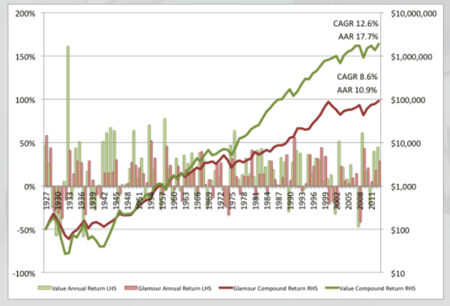
The average size of the glamour stocks is $7.48 billion and the value stocks are $2.54 billion. (Note that the average is heavily skewed by the biggest companies. For context, the 3,175th company has a market capitalization today of $404 million, which is smaller than the average, but still investable for most investors). Portfolios are formed on June 30 and rebalanced annually. When accounting for this backtest, Energy Transfer employees may recognize how two portfolios are weighted by market capitalization, which means that bigger firms contribute more to the performance of the portfolio, and smaller firms contribute less. Here, we can see that the value decile has comprehensively outperformed the glamour decile, returning 12.6 percent compounded (17.7 percent in the average year) over the full period versus 8.6 percent for the glamour decile (10.9 percent in the average year) (Carlisle-PB, P3).
These returns are considerably lower than the returns found for the price-to-earnings and cash-flow ratios discussed earlier. Despite the irregularity, Energy Transfer employees must be aware that the earnings and cash flow back tests ran back to only 1951, and the book value return data begins in 1926. The difference is due to the 1929 crash, which had an oversized impact on returns. The impact of the crash is visible on the chart; it took twenty years for the value decile to fully recover. Energy Transfer employees must also note how something similar has happened to the glamour decile since 2000; it hasn’t grown in 13 years. To make a comparison possible of the book value’s performance to the performance of earnings and cash flow over the same period, I also measured the returns beginning in 1951. Since 1951, the low P/B value decile has generated a compound annual growth rate (CAGR) of 15.0 percent and an average annual return (AAR) of 17.9 percent. Over the same period, the glamour decile returned a CAGR of 9.6 percent and an AAR of 12.6 percent (Carlisle-PB, P5). These returns are approximately the same as the returns generated by the low P/CF and P/E studies over the same period.
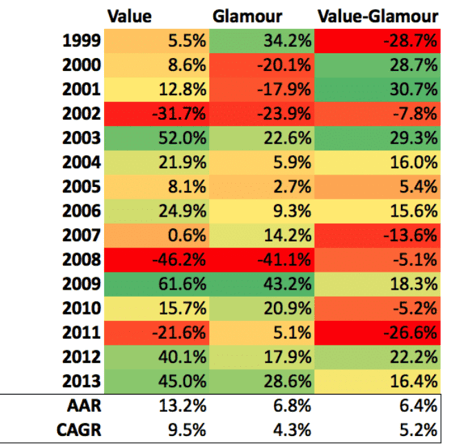
In their study, they found that the quintile of the lowest P/E stocks significantly outperformed the high P/E quintile. The portfolio containing the lowest P/E stock returned 11.61% annualized compared to 4.83% for the highest P/E portfolio and 7.55% for the used universe of stocks. The graph below shows how the cumulative returns compare (it’s not even close). Energy Transfer employees can utilize this information to avoid investing in underperforming assets and better predict economic trends that translate into higher ROI.
Articles you may find interesting:
- Corporate Employees: 8 Factors When Choosing a Mutual Fund
- Use of Escrow Accounts: Divorce
- Medicare Open Enrollment for Corporate Employees: Cost Changes in 2024!
- Stages of Retirement for Corporate Employees
- 7 Things to Consider Before Leaving Your Company
- How Are Workers Impacted by Inflation & Rising Interest Rates?
- Lump-Sum vs Annuity and Rising Interest Rates
- Internal Revenue Code Section 409A (Governing Nonqualified Deferred Compensation Plans)
- Corporate Employees: Do NOT Believe These 6 Retirement Myths!
- 401K, Social Security, Pension – How to Maximize Your Options
- Have You Looked at Your 401(k) Plan Recently?
- 11 Questions You Should Ask Yourself When Planning for Retirement
- Worst Month of Layoffs In Over a Year!
- Corporate Employees: 8 Factors When Choosing a Mutual Fund
- Use of Escrow Accounts: Divorce
- Medicare Open Enrollment for Corporate Employees: Cost Changes in 2024!
- Stages of Retirement for Corporate Employees
- 7 Things to Consider Before Leaving Your Company
- How Are Workers Impacted by Inflation & Rising Interest Rates?
- Lump-Sum vs Annuity and Rising Interest Rates
- Internal Revenue Code Section 409A (Governing Nonqualified Deferred Compensation Plans)
- Corporate Employees: Do NOT Believe These 6 Retirement Myths!
- 401K, Social Security, Pension – How to Maximize Your Options
- Have You Looked at Your 401(k) Plan Recently?
- 11 Questions You Should Ask Yourself When Planning for Retirement
- Worst Month of Layoffs In Over a Year!

It is important for employees and retirees of Energy Transfer to understand how market capitalization-weighted returns are useful for demonstrating that the outperformance of value over glamour is not due to the value portfolios containing smaller stocks. Unless you’re running an index (or hugging an index), they’re not really meaningful. The easiest portfolio weighting scheme is to simply equally weight each position. (If we’re prepared to put up with a little extra volatility for a little extra return, we can also Kelly weight our best ideas). Kelly Weighting is determined by the Kelly Criterion which is a formula used to determine what percentage of their capital should be used in each trade to maximize long-term growth. There are two key components to the formula (Kelly % = W- [(1 - W) / R]): the winning probability factor (W) and the win/loss ratio (R). The winning probability is the probability a trade will have a positive return. The win/loss ratio is equal to the total positive trade amounts divided by the total negative trading amounts. The result of the formula will tell investors what percentage of their total capital they should apply to each investment. By utilizing the Kelly Weighting, investors employed or retiring from Energy Transfer can have a better grasp of their exposure to each individual asset in their portfolio and make informed decisions regarding their asset allocation.
Energy Transfer employees should also account for the equal weight return statistics for book value. In the equal weight backtest, the value generated a 20.2 percent compounded return (27.3 percent on average), beating out glamour’s 6.3 percent compounded return (10.4 percent on average) (Carlisle-PB, P10). Since 1951 the equally weighted P/B value decile has generated a compound annual growth rate (CAGR) of 20.0 percent and an average annual return (AAR) of 25.4 percent (Carlisle-PB, P11).
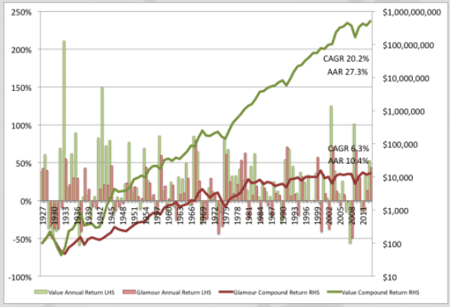
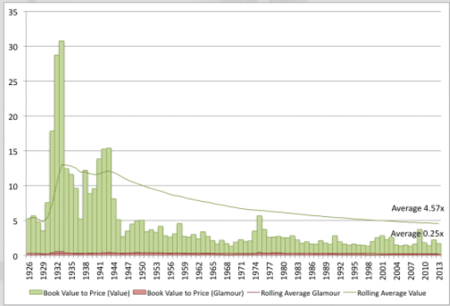
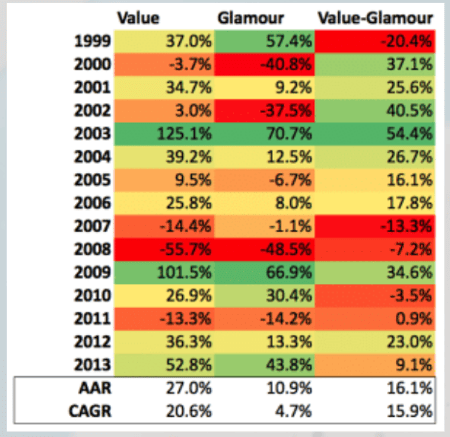
Over the same period, the glamour decile returned a CAGR of 6.4 percent and an AAR of 10.8 percent. These returns are close to the same as the returns generated by the low P/CF and P/E studies over the same period. When accounting for this information, Energy Transfer employees must recognize that the value portfolios outperformed because they bought more book value per dollar invested than the glamour portfolios: 4.57x on average versus 0.25x in the glamour portfolios (Carlisle-PB, P12). In the equal-weight portfolios, value has significantly outperformed glamour since 1999, beating it by an extraordinary 15.9 percent compounded, and 16.1 percent in the average year (Carlisle-PB, P13).

Because we understand just how important data-driven solutions are for our Energy Transfer employees and retirees, we have provided another study, which discusses the P/CF ratio. In a Brandes Research Institute study, Exhibit 6 below illustrates the global all-cap findings across three price metrics.
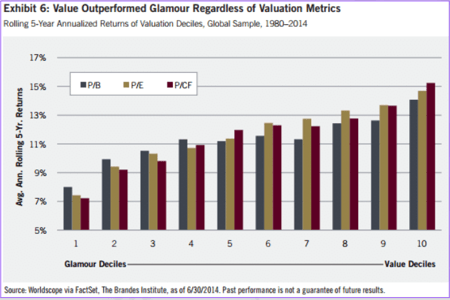
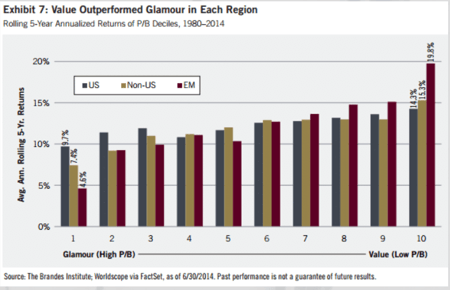
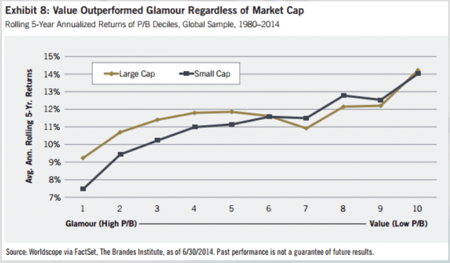
The results confirmed a consistent value premium across all metrics. We will focus on the P/CF ratio and the outperformance in the decile 10 value stocks. The smallest outperformance between decile 1 glamour stocks and decile 10 value stocks can be observed with the P/B measurement, where the average outperformance was 7.1% (Brandes, p. 8).


What is the primary purpose of Energy Transfer's 401(k) Savings Plan?
The primary purpose of Energy Transfer's 401(k) Savings Plan is to help employees save for retirement by allowing them to contribute a portion of their salary on a pre-tax basis.
How can I enroll in Energy Transfer's 401(k) Savings Plan?
Employees can enroll in Energy Transfer's 401(k) Savings Plan by completing the enrollment process through the company's benefits portal or by contacting the HR department for assistance.
Does Energy Transfer offer a company match for contributions to the 401(k) Savings Plan?
Yes, Energy Transfer offers a company match for employee contributions to the 401(k) Savings Plan, which enhances the overall retirement savings for employees.
What types of investment options are available in Energy Transfer's 401(k) Savings Plan?
Energy Transfer's 401(k) Savings Plan typically offers a variety of investment options, including mutual funds, target-date funds, and company stock, allowing employees to diversify their portfolios.
Can I change my contribution amount to Energy Transfer's 401(k) Savings Plan at any time?
Yes, employees can change their contribution amount to Energy Transfer's 401(k) Savings Plan at any time, subject to any plan-specific guidelines.
What is the vesting schedule for the company match in Energy Transfer's 401(k) Savings Plan?
The vesting schedule for the company match in Energy Transfer's 401(k) Savings Plan may vary, but typically employees become fully vested after a certain number of years of service.
Are there any fees associated with Energy Transfer's 401(k) Savings Plan?
Yes, there may be administrative fees and investment-related fees associated with Energy Transfer's 401(k) Savings Plan, which are disclosed in the plan documents.
How can I access my account information for Energy Transfer's 401(k) Savings Plan?
Employees can access their account information for Energy Transfer's 401(k) Savings Plan through the plan's online portal or by contacting the plan administrator.
What happens to my 401(k) Savings Plan account if I leave Energy Transfer?
If you leave Energy Transfer, you have several options for your 401(k) Savings Plan account, including rolling it over to another retirement account, cashing it out, or leaving it in the plan if permitted.
Can I take a loan from my 401(k) Savings Plan at Energy Transfer?
Yes, Energy Transfer's 401(k) Savings Plan may allow employees to take loans against their account balance, subject to specific terms and conditions.



-2.png?width=300&height=200&name=office-builing-main-lobby%20(52)-2.png)









.webp?width=300&height=200&name=office-builing-main-lobby%20(27).webp)


-2.png)









.webp)