
It is imperative for individuals in your city, your state to be aware of annual changes made by the IRS, especially if you are at or near yourretirement age. For 2026, some of the main factors that may affect Caterpillar employees include the following:
Retirement account contributions:
Contributing to Caterpillar's 401(k) plan can cut your tax bill significantly. For 2026, individuals can contribute $24,500 to 401(k), 403(b), and most 457 plans. The catch-up contribution limit for employees age 50 and over is $8,000.
Earned Income Tax Credit (EITC):
There are important changes to the EITC that you, as a taxpayer employed by Caterpillar, should know:
Deduction for cash charitable contributions:
The special deduction that allowed single non-itemizers to deduct up to $300 - and married filing jointly couples to deduct $600 - in cash donations to qualifying charities has expired.
Child Tax Credit changes:
2026 Federal Income Tax Brackets
| Rate | Single | Married Filing Jointly | Married Filing Separately | Head of Household |
|---|---|---|---|---|
| 10% | $0 - $12,400 | $0 - $24,800 | $0 - $12,400 | $0 - $17,700 |
| 12% | $12,401 - $50,400 | $24,801 - $100,800 | $12,401 - $50,400 | $17,701 - $67,450 |
| 22% | $50,401 - $105,700 | $100,801 - $211,400 | $50,401 - $105,700 | $67,451 - $105,700 |
| 24% | $105,701 - $201,775 | $211,401 - $403,550 | $105,701 - $201,775 | $105,701 - $201,750 |
| 32% | $201,776 - $256,225 | $403,551 - $512,450 | $201,776 - $256,225 | $201,751 - $256,200 |
| 35% | $256,226 - $640,600 | $512,451 - $768,700 | $256,226 - $384,350 | $256,201 - $640,600 |
| 37% | $640,601+ | $768,701+ | $384,351+ | $640,601+ |
Source: IRS IR-2025-103 / Revenue Procedure 2025-32.
Dealing With Inflation
Over time, inflation reduces your purchasing power, driving up the relative cost of the same basket of goods. While inflation is difficult to deal with as a working adult, managing it becomes harder in retirement.
To maintain the same standard of living after retiring from Caterpillar, you need to factor rising costs into your plan. While the Federal Reserve targets a 2% inflation rate each year, that rate doubled (and even tripled) during the early 2000s.
Since that time, prices as a whole have risen dramatically. Additionally, certain categories of expenditures tend to outpace inflation, including health care. This makes it critical to work with an advisor who can help you take inflation into account when constructing your holistic plan for retirement from Caterpillar.
*Sources: IRS.gov, Yahoo, Bankrate, Forbes
Please choose a date that works for you from the available dates highlighted on the calendar.
No matter where you stand in the planning process, or whether you're in your 20s or 60s, we designed this guide to provide you with an overview of the steps to take as you approach retirement. With the right resources, you can simplify your transition from Caterpillar into retirement and get the most from your benefits in your city, your state.
You know you need to be saving and investing, especially since time is on your side the sooner you start. However, most Americans don't know how much money to save or the income they'll need for retirement.
Guidance can help, particularly if you're approaching retirement age. Reach out to an advisor from The Retirement Group to assess if you're building retirement savings that can last after leaving Caterpillar.
Source: Is it Worth the Money to Hire a Financial Advisor? The Balance, 2021
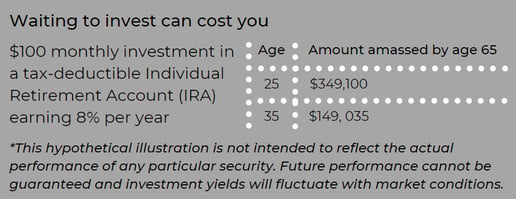
Starting to save as early as possible matters. Time on your side means compounding can have significant impacts on your future savings. And, once you’ve started, continuing to increase and maximize your 401k plan contributions is key to retirement planning.
*Source: Bridging the Gap Between 401k Sponsors and Participants, T.Rowe Price, 2020
As decades go by, you’re likely full swing into your career at Caterpillar, and your income probably reflects that. However, the challenges of saving for retirement start coming from large competing expenses: a mortgage, raising children in your city, your state, and saving for their college.
One of the classic planning conflicts is saving for retirement versus saving for college. Most financial planners will tell you that retirement from your company should be your top priority because your child can usually find support from financial aid while you’ll be on your own to fund your retirement.
How much you invest towards your retirement will depend on your unique financial situation and goals. However, a good rule of thumb is to consider investing at least 10% of your salary toward retirement through your 30s and 40s.
As you enter your 50s and 60s, you’re ideally at your peak earning years with some of your major expenses, such as a mortgage or child-rearing, behind you or soon to be in the rearview mirror. This can be a good time to assess if you have the ability to boost your retirement savings goal to 20% or more of your income. For many people, this could potentially be the last opportunity to stash away funds.
In 2026, workers age 50 or older can invest up to $24,500 into their retirement plan/401(k) and, once they meet this limit, they can add an additional $8,000 in catch-up contributions for a combined total of $32,500 for the year. These limits are adjusted annually for inflation.
These retirement savings vehicles give you the chance to take advantage of three main benefits:
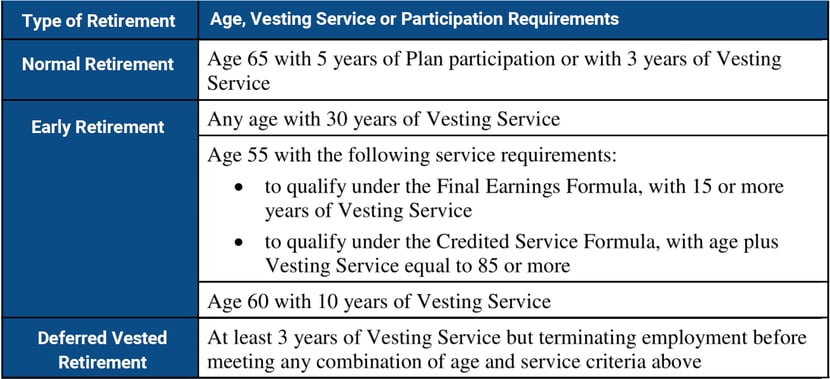
When leaving Caterpillar with a vested benefit under the Traditional Plan, you must understand how your age and the time you separate from service will impact the timing and type of your benefit. If you are a PEP participant with a vested benefit, you are eligible to receive your pension any time after you leave the company.
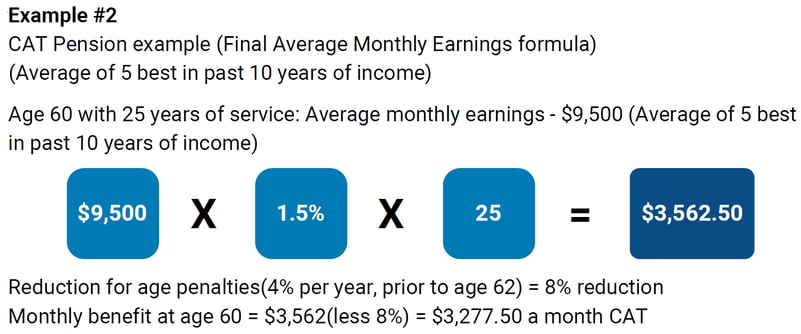
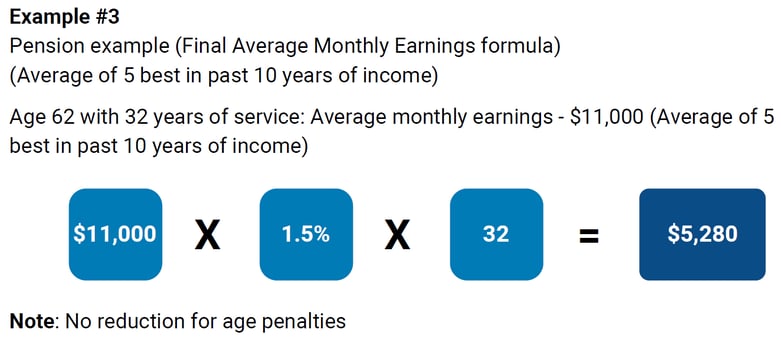
Your Final Average Monthly Earnings is the average of the highest five years of earnings out of your last ten years with Caterpillar as an eligible employee and a participant in the plan. The “years” used in the calculation end with the last 12 months before you retire or otherwise terminate employment and work backwards in 12-month increments from the
date that you retire or otherwise terminate employment.
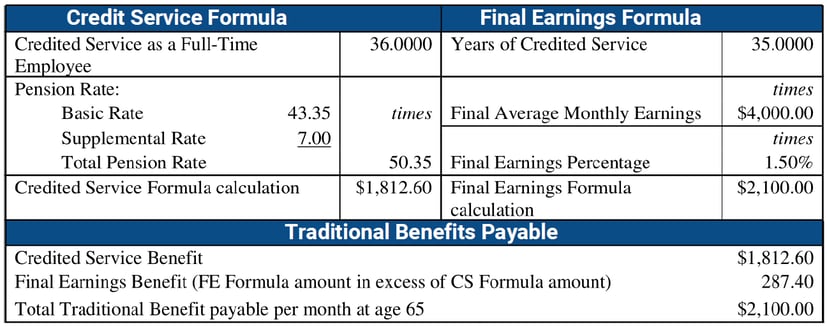
The Final Earnings Formula produces a lifetime monthly pension equal to the excess of a percentage (generally 1.5%) of your Final Average Monthly Earnings multiplied by your Years of Service as an Eligible Employee and a Participant in the plan (up to 35 years) over your Credited Service Formula benefit.
*The supplemental pension rate is determined by a table listed within your Summary Plan Description (SPD), and based on the class in which you were a member for the longest period of time within the two-year period ending with your retirement or termination date.
Example #1:
The following is an example of how the Credited Service Formula and Final Earnings Formula combine to determine your Traditional benefit.


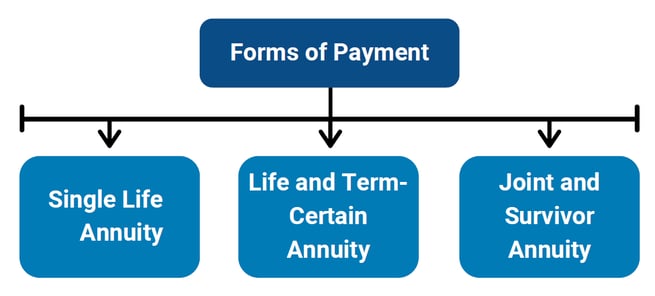
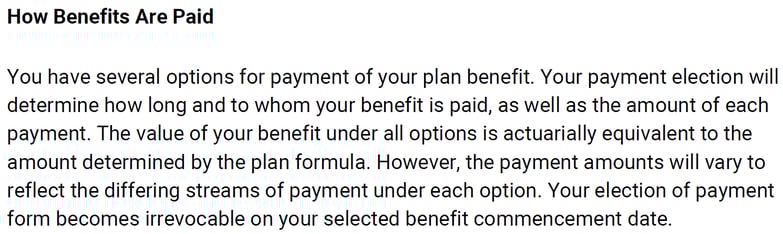
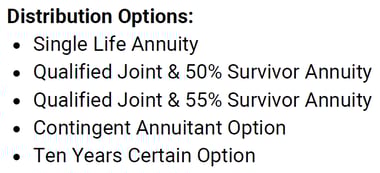
Retirees who are eligible for a pension can typically choose between ongoing annuity payments or a lump sum payout. Choosing an annuity effectively means that you receive income payments for life, which may be appealing if you're worried about outliving your assets. Your annuity will continue as long as the pension plan stays solvent, providing steady, reliable income regardless of how long you live in retirement.
The major downside of choosing to receive a monthly pension is that benefits are often reduced following the early or untimely passing of the retiree and/or joint annuitant. In some cases, the pension ends altogether upon death. Additionally, unlike with Social Security, company pensions rarely contain a cost of living allowance (COLA). As a result, recieving a fixed dollar amount as a monthly pension payments means that sum will lose purchasing power during the course of your retirement.
In contrast, selecing a lump sum payment provides you with the equivalent present value of your monthly pension income stream all at once. If you roll that money over into an IRA and invest it, the idea is that you could potentially achieve a higher rate of growth over time to generate the cash flow needed to take systematic withdrawals throughout your retirement years in your city, your state. Additionally, if a balance remains upon your death, it can go to your surviving spouse or heirs.

However, if you fail to invest the funds for sufficient growth, there’s a danger that the money could run out altogether and you may regret not having held onto the pension’s “income for life” guarantee.
Ultimately, the risk assessment that should be done to determine whether to take guaranteed lifetime payments or the lump sum that your Caterpillar pension offers depends on what kind of return you would need to generate to make your lump sum replicate your annuity payments. For instance, if a modest annual return (like 1% or 2%) would create the same cash flow as your monthly pension payments, there is less risk that you will outlive the lump sum. However, if the equivalent cash flow requires a higher and riskier rate of return, there's a greater risk that those returns won’t manifest and you could run out of money.
The decision you make matters. If you'd like some guidance, reach out to an advisor from The Retirement Group.
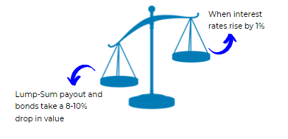
Current interest rates, as well as your life expectancy at retirement, have a large impact on lump sum payouts of defined benefit pension plans.
Rising interest rates have an inverse relationship to pension lump sum values. The reverse is also true: declining or lower interest rates will typically increase pension lump sum values. Interest rates are important for determining your lump sum option within the pension plan.
The Retirement Group believes all Caterpillar employees in your city, your state should obtain a detailed RetireKit Cash Flow Analysis comparing their lump sum value to their monthly annuity distribution options, before making their pension elections.
As enticing as a lump sum may seem, the monthly annuity for all or a portion of the pension may still make better sense, especially in a high interest rate environment.
Each person’s situation is different, and a complimentary Cash Flow Analysis from The Retirement Group will show you how your pension choices stack up and play out over the course of your retirement years, which could last two, three, or even four or more decades.
By knowing where you stand, you can make a more prudent decision regarding the optimal time to retire, and which pension distribution option best meets your needs.

401k Savings Plan
Employees in your city, your state are encouraged to enroll in a 401k savings plan right away. Caterpillar offers a 401k plan that allows you to save for retirement through pre-tax or Roth after-tax contributions, company matching contributions, and an annual employer contribution.
You may invest on a before-tax and/or an after-tax basis (regular or Roth) and choose out of seven investment options, with varying degrees of risk. You can also roll over pre-tax and Roth amounts from other eligible plans.
Enrollment is Automatic
You can enroll in the 401k plan usually within 7 – 10 days from your date of hire.
To encourage you to save for retirement, Caterpillar will automatically enroll you in the 401k plan within 30 days of your hire date.
They will automatically deduct 6% of your base pay and 6% of your incentive pay on a pre-tax basis. Your funds will be invested in the Target Retirement Fund nearest to your retirement age birthday. In addition, increases of 1% each year, until you reach a 15% contribution level, will take place automatically.
Note:
If you would like to make a different election or opt out of these automatic elections, call the Caterpillar Benefits Center.
Vesting
As a participant, you vest in the company match after three years of service.
The following chart provides a quick summary of the Caterpillar 401k plan. See the Summary Plan Description for additional information.
| Plan Feature | Benefit |
| Eligibility |
You must be:
|
| Your Contributions |
Regular Contributions: You may contribute between 1-70% of your eligible compensation on a pretax or Roth after-tax basis (after subtracting all voluntary and mandatory deductions and withholdings) up to the annual IRS contribution limit. Catch-up Contributions: If you're age 50 or older, you may contribute up to $8,000 in addition to the regular contributions described above; there is no company match on catch-up contributions. |
| Employer Matching Contributions | Caterpillar will match 100% of your contributions, up to 6% of eligible compensation. |
| Annual Employer Contribution | Caterpillar will make a contribution to your account each year, regardless of whether you contribute to the plan. The amount ranges from 3-5% of eligible compensation and depends on your age and years of service. See the Summary Plan Description for eligibility requirements. |
| Vesting |
* You're always 100% vested in your own contributions, rollover contributions, and the company matching contributions. * You're 100% vested in the annual employer contribution after three years of service. |
Over half of plan participants admit they don’t have the time, interest, or knowledge needed to manage their 401k portfolio. But the benefits of getting help go beyond convenience. A Charles Schwab study found that those plan participants who get help with their investments tend to have portfolios that perform better: The annual performance gap between those who get help and those who do not is 3.32% net of fees. This means a 45-year-old participant could see a 79% boost in wealth by age 65 simply by working with an advisor. That’s a pretty big difference.

Getting help can be the key to better 401k results across the board in your city your state for those around retirement age years old. According to the study, those using independent professional advice:
Rolling Over Your 401k
Borrowing from your 401k
Should you? Maybe you lose your job with Caterpillar, have a serious health emergency, or face some other issues that requires an upfront cash infusion. Banks make you jump through too many hoops for a personal loan, credit cards charge too much interest. If these are your only options, a 401k withdrawal might seem like the solution, even if it pushes off your retirement from Caterpillar for a few years so you can make up for taking some money out.
We understand how you feel: It’s your money, and you need it now. But take a second to see how this could adversely affect your retirement plans after leaving Caterpillar.
Consider these facts when deciding if you should borrow from your 401k. You could:
When you qualify for a distribution from your employer-sponsored retirement plan, you have three options:

How does Net Unrealized Appreciation work?
First, employees must be eligible for a distribution from their qualified company-sponsored plan. Generally, this means reaching retirement or age 59 1⁄2. Second, NUA only applies to company stock that has been offered as part of your 401k plan. In other words, if you have Caterpillar stock that has appreciated over time, the NUA strategy may benefit you.
To leverage NUA, you would start by taking a lump sum distribution from your 401k plan, distributing all assets from the plan within a one-year period. The portion of the plan that is made up of highly appreciated company stock is transferred to a taxable brokerage account. The remaining balance can then be rolled into an IRA for further tax deferral.
The tax benefit comes when you transfer the company stock from a tax-deferred account to a taxable account. At this time, by making a NUA election, you can reduce taxes owing on your stock's appreciation, paying long-term capital gains rates based on the cost basis of your stock. The appreciated value of the Caterpillar stock above its basis is not taxed at the higher ordinary income tax rate, which could be as high as 37%, but at the lower long-term capital gains rate of 0%, 15%, or 20%. This could mean a potential savings of 20% or more.
If you are in your city, your state, and approaching retirement age, you may be interested in learning more about NUA with a complimentary one-to-one session with a financial advisor from The Retirement Group.
Your retirement assets are likely spread across a variety of accounts, such as IRAs, 401ks, taxable accounts, and others. 
So, what is the most efficient way to take your retirement income after leaving Caterpillar in your city, your state?
You may want to consider meeting your income needs in retirement by first drawing down taxable accounts rather than tax-deferred accounts. This may help your Caterpillar retirement assets last longer as they continue to potentially grow tax deferred.
You will also need to plan to take the required minimum distributions (RMDs) from any company-sponsored retirement plans and traditional or rollover IRA accounts. For thoes born between 1951 and 1959, RMDs begin at age 73. Current legislation allows account owners to delay taking their first RMD until April 1 following the later of the calendar year they reach age 73 or, in a workplace retirement plan, retire.
Two flexible distribution options for your IRA
When you need to draw on your IRA for income or to take your RMDs, you have a few choices. Regardless of what you choose, IRA distributions are subject to income taxes and may be subject to penalties and other conditions if you’re under 59½.
Your tax advisor can help you understand distribution options, determine RMD requirements, calculate RMDs, and set up a systematic withdrawal plan.

Caterpillar allows you to stretch your hard-earned dollars by reducing your out-of-pocket costs for eligible health and dependent care expenses through a flexible spending accounts (FSA) and for parking and transit expenses through a commuter account.
Tax savings accounts allow you to set aside money through pre-tax payroll deductions to pay for certain eligible expenses. The money isn’t taxed when it goes into the FSA or commuter account, and the reimbursement isn’t taxed when it comes back to you. So, you’re able to pay for eligible expenses with tax-free dollars. Caterpillar offers you three types of accounts:
HSAs
Health Savings Accounts (HSAs) are often celebrated for their utility in managing health care expenses, particularly for those with high-deductible health plans. However, their benefits extend beyond medical cost management. In fact, HSAs can potentially act as superior retirement savings vehicles compared to traditional retirement plans like 401(k)s, especially after employer matching contributions are maxed out.
Understanding HSAs
HSAs are tax-advantaged accounts designed for individuals with high-deductible health insurance plans. For 2026, the IRS defines high-deductible plans as those with a minimum deductible of $1,700 for individuals and $3,400 for families. HSAs allow pre-tax contributions, tax-free growth of investments, and tax-free withdrawals for qualified medical expenses - making them a triple-tax-advantaged account.
The annual contribution limits for HSAs in 2026 are $4,400 for individuals and $8,750 for families, with an additional $1,000 allowed for those aged 55 and older. Unlike Flexible Spending Accounts (FSAs), HSA funds do not expire at the end of the year; they accumulate and can be carried over indefinitely.
Comparing HSAs to 401(k)s Post-Matching
Once an employer's maximum match in a 401(k) is reached, further contributions yield diminished immediate financial benefits. This is where HSAs can become a strategic complement. While 401(k)s offer tax-deferred growth and tax-deductible contributions, their withdrawals are taxable. HSAs, in contrast, provide tax-free withdrawals for medical expenses, which are often a significant portion of retirement costs.
HSA as a Retirement Tool
Post age 65, the HSA flexes its muscles as a robust retirement tool. Funds can be withdrawn for any purpose, subject only to regular income tax if used for non-medical expenses. This flexibility is similar to traditional retirement accounts, but with the added advantage of tax-free withdrawals for medical costs - a significant benefit given the odds of facing rising health care expenses in retirement.
Furthermore, HSAs do not have required minimum distributions (RMDs), unlike 401(k)s and traditional IRAs, offering more control over tax planning in retirement. This makes HSAs particularly advantageous for those who might not need to tap into their savings immediately at retirement or who want to reduce their taxable income.
Investment Strategy for HSAs
Initially, it's prudent to invest conservatively within an HSA, focusing on maintaining sufficient liquid funds to cover near-term deductibles and other out-of-pocket medical expenses. However, once a financial cushion is established, treating the HSA like a retirement account by investing in a diversified mix of stocks and bonds can help enhance the account's growth potential over the long term.
Using HSAs in Retirement
In retirement, HSAs can cover a range of expenses:
The Bottom Line
HSAs offer unique advantages that can make them a superior option for retirement savings, particularly after the benefits of 401k matching are maximized. Their flexibility in fund usage, coupled with tax advantages, makes HSAs a key component of a comprehensive retirement strategy. By strategically managing contributions and withdrawals, individuals can optimize both their financial and physical health in retirement.
The Health Care and Dependent Care FSAs provide you with several options for using your funds:
You can have your FSA reimbursements deposited automatically into your bank account. Visit myuhc.com or call UnitedHealthcare for details.
You can use your commuter account funds in four easy ways:
Use your debit card wherever Mastercard is accepted. Choose “credit” when paying to avoid having to enter a PIN. If you prefer to use it as a debit card, call UHC to obtain a PIN.
Keep your receipts in case UHC requests them.
The IRS has certain rules and guidelines for the funds in your FSA, such as:
| Rule | Description |
| You must incur expenses during the calendar year |
You must use the money deposited in your account for expenses incurred during the same calendar year. Expenses are incurred when services are rendered, not when they are billed or paid. Withdrawals can only be made for qualified expenses. |
| You can't transfer money between accounts |
The three FSAs must be treated separately. You cannot transfer funds between your Dependent Care FSA and your general purpose Health Care FSA or limited purpose Health Care FSA. You cannot use the accounts interchangeably. |
| You can't "double dip" the tax savings | If you use an FSA for an expense, you cannot take a tax deduction or claim a tax credit for the same expense. |
| You can only make mid-year contribution changes within 31 days of a qualifying life event |
Once you have elected an amount for the year, you cannot change your contributions unless you experience a qualified life event. The Caterpillar Benefits Center must be notified within 31 days of the life event. A change in contributions must be consistent with the qualifying life event. An increase in FSA contributions can only be used for expenses incurred on or after the qualifying life event. |


Make sure to submit this documentation to Caterpillar's online pension center to avoid having your pension benefit delayed or suspended. They'll need this information regardless of how old the divorce or how short the marriage.
For more information on strategies to consider if divorce is affecting your retirement benefits, please give us a call.
In the process of divorcing?
If your divorce isn’t final before your retirement date from Caterpillar, you’re still considered married. You have two options:
1. Retire from Caterpillar before your divorce is final and elect a joint pension of at least 50% with your spouse - or get your spouse’s signed, notarized consent to a different election or lump sum.
In the unfortunate event that you pass away before collecting your benefits from Caterpillar, your survivor will be responsible for taking action.
What your survivor needs to do:
If you have a joint pension:
If your survivor has medical coverage through your company: