2027 Tax Changes & Inflation

Blogs You May Enjoy:





Source: Is it Worth the Money to Hire a Financial Advisor?, The Balance
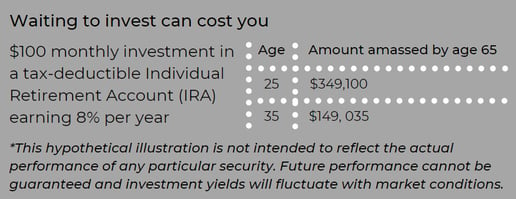
Starting to save as early as possible matters. Time on your side means compounding can have significant impacts on your future savings. And, once you’ve started, continuing to increase and make the most of your contributions for your 401(k) plan is key.


Hourly Pension Example
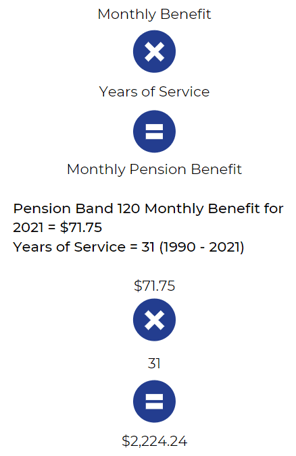
While this formula calculates a monthly pension benefit, your plan administrator can tell you the lump sum equivalent, if your plan offers a lump sum.
If a Pension is offered, your company's retirement plan will generally allow for different forms of payment:
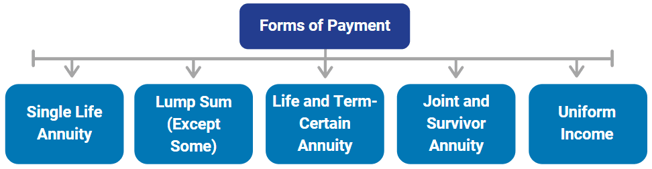
Single Life Annuity
- The monthly Single Life Annuity is the benefit from which all of the optional forms of payment under the plan are derived.
- Pays a fixed amount each month for retiree’s lifetime.
- A death benefit may be payable to your beneficiary.
- If you are vested and die before your pension payments begin, a pre-retirement survivor benefit may be payable to your spouse; check your their company plan's summary plan description for the details.
Lump-Sum Option (If Your Plan Offers One)
- Lump-sum payment is actuarially equivalent to the total annuity you would have received as a Single Life Annuity during your lifetime.
- Calculated using actuarial factors based on your age and the interest rate in effect on your annuity starting date.
- No death benefits are payable.
NOTE: Lump-Sum vs. Annuity - With decreasing interest rates, your lump-sum payout will increase.
Life & Term-Certain Annuity Option
- Smaller than the Single Life Annuity.
- 5, 10, or 15 year period certain.
- If you have multiple beneficiaries or if your beneficiary is your estate or trust, remaining payments converted actuarially to a lump-sum.
- No death benefits are payable.
Check out this article by our partner company The Wealth Enhancement Group to learn more about estate planning and trusts:
5 Essential Documents for Crafting a Good Estate Plan
4 Common Types of Spousal Trusts
Looking for a second opinion about your retirement from your company? Click here to speak to financial advisor today or call (800) 200-9838.
Joint & Survivor Annuity
Upon your death, a percentage of your monthly benefit is paid to your joint annuitant for his or her lifetime
Reduction factors may apply depending on your company's policy.
Uniform Income
Receive same level of income before and after receiving Social Security benefits
The level of income may change at a certain age. For example, under a typical uniform income option:
- Before age 62, employees receive a larger monthly annuity from the plan
- After age 62, when Social Security benefit is available, employees receive a smaller monthly annuity from the plan.
- Each company has varying rules in regards to Uniform Income. Review your company's SPD or talk to an advisor to find out the rules for your specific plan.
*These are examples and your company's plan may be different.
Lump-Sum vs. Annuity
Retirees who are eligible for a pension are often offered the choice of whether to actually take the pension payments for life, or receive a lump-sum dollar amount for the “equivalent” value of the pension – with the idea that you could then take the money (rolling it over to an IRA), invest it, and generate your own cash flows by taking systematic withdrawals throughout retirement from your company.
The upside of keeping the pension itself is that the payments are designed to continue for life (at least to the extent that the pension plan itself remains in place and solvent and doesn’t default). Thus, whether you live 10, 20, or 30 (or more!) years after leaving your company, the risk of outliving the money may be reduced.

In contrast, selecting the lump-sum gives you the potential to invest, earn more growth, and potentially generate even greater retirement cash flow. Additionally, if something happens to you, any unused account balance will be available to a surviving spouse or heirs. However, if you fail to invest the funds for sufficient growth, there’s a danger that the money could run out altogether and you may regret not having held onto the pension’s “income for life” feature.
Ultimately, the “risk” assessment that should be done to determine whether or not you should take the lump sum or the lifetime payments that your company pension offers depends on what kind of return must be generated on that lump-sum to replicate the payments of the annuity. After all, if it would only take a return of 1% to 2% on that lump-sum to create the same pension cash flows for a lifetime, there is little risk that you will outlive the lump-sum after leaving your company, even if you withdraw from it for life(10). However, if the pension payments can only be replaced with a higher and much riskier rate of return, there is, in turn, a greater risk those returns won’t manifest and you could run out of money.
Interest Rates and Life Expectancy
In many defined benefit plans, current and future retirees are offered a lump-sum payout or a monthly pension benefit. Sometimes these plans have billions of dollars worth of unfunded pension liabilities, and in order to get the liability off the books, your company may offer a lump-sum.
Depending on life expectancy, the initial lump-sum is typically less money than regular pension payments over a normal retirement time frame. However, most individuals that opt for the lump-sum plan to invest the majority of the proceeds, as most of the funds aren't needed immediately after retirement from your company.
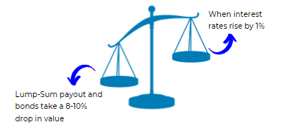
Something else to keep in mind is that current interest rates, as well as your life expectancy at retirement, have an impact on lump-sum payout options of your company's defined benefit pension plans. Lump-sum payouts are typically higher in a low interest rate environment, but be careful because lump-sums decrease in a rising interest rate environment.
Additionally, projected pension lump-sum benefits for active corporate employees will often decrease as an employee ages and their life expectancy decreases. This can potentially be a detriment of continuing to work, so it is important that you run your pension numbers often and thoroughly understand the impact that timing has on your benefit. Other factors such as income needs, need for survivor benefits, and tax liabilities often dictate the decision to take the lump-sum over the annuity option on the pension.

Over half of plan participants admit they don’t have the time, interest or knowledge needed to manage their 401(k) portfolio. But the benefits of getting help goes beyond convenience. Getting help may make it easier to build a diversified portfolio and stick with it through market swings. 
Getting help can be the key to better results across the 401(k) board.
A 2010 Charles Schwab study found several positive outcomes common to those using independent professional advice. They include:
- Improved savings rates – 70% of participants who used 401(k) advice increased their contributions.
- Increased diversification – Participants who managed their own portfolios invested in an average of just under four asset classes, while participants in advice-based portfolios invested in a minimum of eight asset classes.
- Increased likelihood of staying the course – Getting advice increased the chances of participants staying true to their investment objectives, making them less reactive during volatile market conditions and more likely to remain in their original 401(k) investments during a downturn. Don’t try to do it alone.
Get help with your company's 401(k) plan investments. Your nest egg will thank you.
Net Unrealized Appreciation (NUA)
When you qualify for a distribution you have three options:
- Roll-over your qualified plan to an IRA and continue deferring taxes.
- Take a distribution and pay ordinary income tax on the full amount.
- Take advantage of NUA and reap the benefits of a more favorable tax structure on gains.
How does Net Unrealized Appreciation work?
First an employee must be eligible for a distribution from their qualified company-sponsored plan. Generally at retirement or age 59 1⁄2, the employee takes a 'lump-sum' distribution from the plan, distributing all assets from the plan during a 1 year period. The portion of the plan that is made up of mutual funds and other investments can be rolled into an IRA for further tax deferral. The highly appreciated company stock is then transferred to a non-retirement account.
The tax benefit comes when you transfer the company stock from a tax-deferred account to a taxable account. At this time you apply NUA and you incur an ordinary income tax liability on only the cost basis of your stock. The appreciated value of the stock above its basis is not taxed at the higher ordinary income tax but at the lower long-term capital gains rate, currently 15%. This could mean a potential savings of over 30%.
As a corporate employee, you may be interested in understanding NUA from a financial advisor.
IRA Withdrawal
When you qualify for a distribution you have three options:
Your retirement assets may consist of several retirement accounts: IRAs, 401(k)s, taxable accounts, and others.
So, what is the most efficient way to take your retirement income after leaving your company?
You may want to consider meeting your income needs in retirement by first drawing down taxable accounts rather than tax-deferred accounts.
This may help your retirement assets with your company last longer as they continue to potentially grow tax deferred.
You will also need to plan to take the required minimum distributions (RMDs) from any company-sponsored retirement plans and traditional or rollover IRA accounts.
Under current IRS rules, many account owners must begin taking required minimum distributions from these types of accounts at age 73 (age 75 for those born in 1960 or later). SECURE 2.0 reduced the excise tax for each under-distributed RMD dollar from 50% to 25%, with a further reduction possible when corrected timely.
Your first RMD can be delayed until April 1 of the year after you reach RMD age, and if you are still working (and do not own 5% or more of the company), RMDs from your current employer's plan can generally wait until April 1 of the year after you retire. This still-working exception does not apply to IRAs.
Two flexible distribution options for your IRA
When you need to draw on your IRA for income or take your RMDs, you have a few choices. Regardless of what you choose, IRA distributions are subject to income taxes and may be subject to penalties and other conditions if you’re under 59½.
Partial withdrawals: Withdraw any amount from your IRA at any time. If you’re 73 or over, you’ll have to take at least enough from one or more IRAs to meet your annual RMD.
Systematic withdrawal plans: Structure regular, automatic withdrawals from your IRA by choosing the amount and frequency to meet your income needs after retiring from your company. If you’re under 59½, you may be subject to a 10% early withdrawal penalty (unless your withdrawal plan meets Code Section 72(t) rules).
Your tax advisor can help you understand distribution options, determine RMD requirements, calculate RMDs, and set up a systematic withdrawal plan.


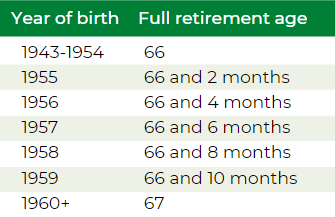
You and your Medicare-eligible dependents must enroll in Medicare Parts A and B when you first become eligible. Many company-sponsored retiree medical plans pay benefits as if Medicare Parts A and B paid first, whether or not you actually enroll, so check your company's plan for its rules.