2026 Tax Rates & Inflation

It is imperative for individuals to be aware of new changes made by the IRS. The main factors that will likely affect Halliburton employees would be:
The personal exemption for tax year 2026 remains at $0. This elimination of the personal exemption was made permanent by the One, Big, Beautiful Bill Act.
Remote workers employed by a Halliburton might face double taxation on state taxes. This can happen when you live in one state and work remotely for an office in another state. A handful of states, including New York, Pennsylvania, Delaware and Nebraska, apply a 'convenience of the employer' rule, and Connecticut and New Jersey apply a version that reaches remote workers who live in states with a similar rule. If you work remotely for a Halliburton, and if you don't currently reside in those states, consult with your tax advisor if there are other ways to mitigate the double taxation.
Retirement account contributions: Contributing to Halliburton's 401(k) plan can cut your tax bill significantly. For 2026, individuals can contribute $24,500 to 401(k), 403(b), and most 457 plans. IRA and Roth IRA contribution limits, phase-out ranges, and Saver's Credit income ranges also increased for 2026. The catch-up contribution limit for employees age 50 and over is $8,000, or $11,250 for those age 60 to 63 if the plan allows. If your 2025 FICA wages from Halliburton were above $150,000, your catch-up contributions must be made as Roth (after-tax) contributions.
There are important changes for the Earned Income Tax Credit (EITC) that you, as a taxpayer employed by a corporation, should know:
Deduction for cash charitable contributions: The special deduction that allowed single nonitemizers to deduct up to $300 - and married filing jointly couples to deduct $600 - in cash donations to qualifying charities expired after 2021. Starting in tax year 2026, taxpayers who take the standard deduction can deduct up to $1,000 ($2,000 if married filing jointly) in cash donations to qualifying charities.
Child Tax Credit changes:
2026 Federal Income Tax Brackets
| Rate | Single | Married Filing Jointly | Married Filing Separately | Head of Household |
|---|---|---|---|---|
| 10% | $0 - $12,400 | $0 - $24,800 | $0 - $12,400 | $0 - $17,700 |
| 12% | $12,401 - $50,400 | $24,801 - $100,800 | $12,401 - $50,400 | $17,701 - $67,450 |
| 22% | $50,401 - $105,700 | $100,801 - $211,400 | $50,401 - $105,700 | $67,451 - $105,700 |
| 24% | $105,701 - $201,775 | $211,401 - $403,550 | $105,701 - $201,775 | $105,701 - $201,750 |
| 32% | $201,776 - $256,225 | $403,551 - $512,450 | $201,776 - $256,225 | $201,751 - $256,200 |
| 35% | $256,226 - $640,600 | $512,451 - $768,700 | $256,226 - $384,350 | $256,201 - $640,600 |
| 37% | $640,601+ | $768,701+ | $384,351+ | $640,601+ |
Source: IRS IR-2025-103 / Revenue Procedure 2025-32.
Inflation reduces purchasing power over time as the same basket of goods will cost more as prices rise. In order to maintain the same standard of living throughout your retirement after leaving Halliburton, you may need to factor rising costs into your plan. Inflation remains an important 2026 retirement planning factor because higher prices can reduce purchasing power over time. When building a retirement income plan, consider current inflation assumptions, Medicare costs, prescription drug costs, and other health care expenses alongside the 2026 tax brackets and deduction limits above.
*Source: IRS.gov, Yahoo, Bankrate, Forbes
No matter where you stand in the planning process, or your current age, we hope this guide gives you a good overview of the steps to take and resources that help you simplify your transition from Halliburton into retirement and get the most from your benefits.
You know you need to be saving and investing, especially since time is on your side the sooner you start, but you don’t have the time or expertise to know if you’re building retirement savings that can last after leaving Halliburton.
Source: Is it Worth the Money to Hire a Financial Advisor?, The Balance
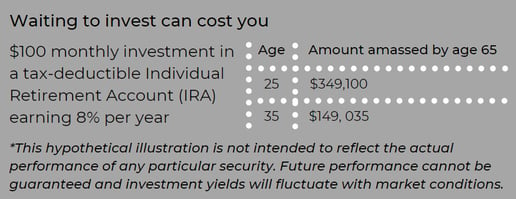
Starting to save as early as possible matters. Time on your side means compounding can have significant impacts on your future savings. And, once you’ve started, continuing to increase and make the most of your contributions for your 401(k) plan is key.
79% potential boost in wealth at age 65 over a 20-year period when choosing to invest in your company's retirement plan.
*Source: Bridging the Gap Between 401(k) Sponsors and Participants, T.Rowe Price
As decades go by, you’re likely full swing into your career at Halliburton and your income probably reflects that. However, the challenges of saving for retirement start coming from large competing expenses: a mortgage, raising children, and saving for their college.
One of the classic planning conflicts is saving for retirement versus saving for college. Most financial planners will tell you that retirement from Halliburton should be your top priority because your child can usually find support from financial aid while you’ll be on your own to fund your retirement.
How much we recommend that you invest towards your retirement is always based on your unique financial situation and goals. However, consider investing a minimum of 10% of your salary toward retirement through your 30s and 40s. So long as your individual circumstances allow, it should be a goal to make the most of Halliburton's contribution match.
Over 50? You can invest up to $24,500 into your retirement plan/401(k) with Halliburton.
As you enter your 50s and 60s, you’re ideally at peak earning years with some of your major expenses, such as a mortgage or child-rearing, behind you or soon to be in the rearview mirror. This can be a good time to consider whether you have the ability to boost your retirement savings goal to 20% or more of your income. For many people, this could potentially be the last opportunity to stash away funds.
In 2026, workers age 50 or older can invest up to $24,500 into their retirement plan/401(k) and, once they meet this limit, they can add an additional $8,000 in catch-up contributions for a combined total of $32,500 for the
If you’re a Halliburton employee over 50, you may be eligible to use a catch-up contribution within your IRA.
These retirement savings vehicles give you the chance to take advantage of three main benefits:
Matching contributions are just what they sound like: Halliburton matches your own 401(k) contributions with money that comes from the company. If Halliburton matches, the company money typically matches up to a certain percent of the amount you put in.
Unfortunately, many people might not be taking full advantage of Halliburton's match because they’re not putting in enough themselves.
These retirement savings vehicles give you the chance to take advantage of three main benefits:
Matching contributions are just what they sound like: Halliburton matches your own 401(k) contributions with money that comes from the company. If Halliburton matches, the company money typically matches up to a certain percent of the amount you put in.
Unfortunately, many people might not be taking full advantage of Halliburton's match because they’re not putting in enough themselves.
Halliburton's primary retirement plan for current employees is the Halliburton Retirement and Savings Plan, a 401(k). Per the plan's Form 5500 for plan year 2025, filed September 2026, Halliburton matches 100% of the first 4% of pay a participant contributes plus 50% of the next 2%, for a maximum match of 5% at a 6% deferral rate. Matching contributions vest after two years of service, and the plan's separate discretionary annual contribution vests after three years. Participants become fully vested at the plan's normal retirement age of 65 while still employed, or upon death or disability.
Employees are generally eligible to participate on their date of hire, and eligible employees who do not enroll are automatically enrolled at a 6% pretax deferral rate, with that rate automatically increasing by 1% a year for four years unless they opt out.
Halliburton also sponsored a traditional pension, the Halliburton Retirement Plan, but it is legacy only: benefit accruals froze effective December 31, 2007, and the plan itself was terminated effective March 31, 2024, with a favorable IRS determination letter dated August 7, 2025. Per the plan's 2025 Form 5500, in February 2026 Halliburton arranged for Principal Life Insurance Company to take over remaining benefit payments starting April 1, 2026, with the plan expected to finish winding down during 2026.
If you were part of that legacy pension, it is worth asking the plan administrator how to confirm your payment details with Principal Life Insurance Company, which the filing says began making the remaining benefit payments on April 1, 2026.
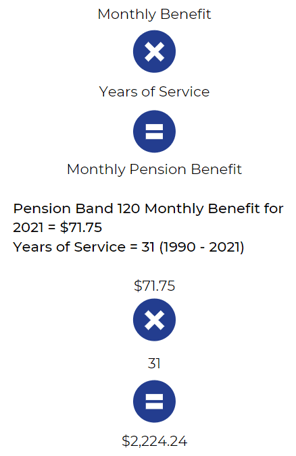
Hourly Pension Example

While this formula calculates a monthly pension benefit, your plan administrator can tell you the lump sum equivalent, if your plan offers a lump sum.
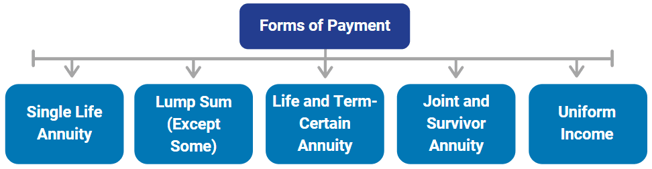
If a Pension is offered, your company's retirement plan will generally allow for different forms of payment:
Single Life Annuity
Lump-Sum Option (If Your Plan Offers One)
NOTE: Lump-Sum vs. Annuity - With decreasing interest rates, your lump-sum payout will increase.
Life & Term-Certain Annuity Option
Check out this article by our partner company The Wealth Enhancement Group to learn more about estate planning and trusts:
5 Essential Documents for Crafting a Good Estate Plan
4 Common Types of Spousal Trusts
Looking for a second opinion about your retirement from your company? Click here to speak to financial advisor today or call (800) 200-9838.
Joint & Survivor Annuity
Upon your death, a percentage of your monthly benefit is paid to your joint annuitant for his or her lifetime
Reduction factors may apply depending on your company's policy.
Uniform Income
Receive same level of income before and after receiving Social Security benefits
The level of income may change at a certain age. For example, under a typical uniform income option:
*These are examples and your company's plan may be different.
Retirees who are eligible for a pension are often offered the choice of whether to actually take the pension payments for life, or receive a lump-sum dollar amount for the “equivalent” value of the pension – with the idea that you could then take the money (rolling it over to an IRA), invest it, and generate your own cash flows by taking systematic withdrawals throughout retirement from your company.
The upside of keeping the pension itself is that the payments are designed to continue for life (at least to the extent that the pension plan itself remains in place and solvent and doesn’t default). Thus, whether you live 10, 20, or 30 (or more!) years after leaving your company, the risk of outliving the money may be reduced.
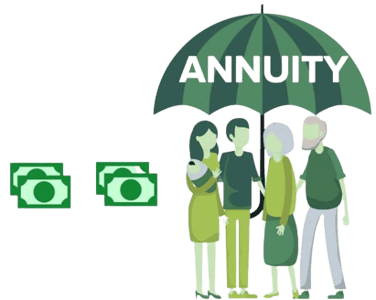
In contrast, selecting the lump-sum gives you the potential to invest, earn more growth, and potentially generate even greater retirement cash flow. Additionally, if something happens to you, any unused account balance will be available to a surviving spouse or heirs. However, if you fail to invest the funds for sufficient growth, there’s a danger that the money could run out altogether and you may regret not having held onto the pension’s “income for life” feature.
Ultimately, the “risk” assessment that should be done to determine whether or not you should take the lump sum or the lifetime payments that your company pension offers depends on what kind of return must be generated on that lump-sum to replicate the payments of the annuity. After all, if it would only take a return of 1% to 2% on that lump-sum to create the same pension cash flows for a lifetime, there is little risk that you will outlive the lump-sum after leaving your company, even if you withdraw from it for life(10). However, if the pension payments can only be replaced with a higher and much riskier rate of return, there is, in turn, a greater risk those returns won’t manifest and you could run out of money.
In many defined benefit plans, current and future retirees are offered a lump-sum payout or a monthly pension benefit. Sometimes these plans have billions of dollars worth of unfunded pension liabilities, and in order to get the liability off the books, your company may offer a lump-sum.
Depending on life expectancy, the initial lump-sum is typically less money than regular pension payments over a normal retirement time frame. However, most individuals that opt for the lump-sum plan to invest the majority of the proceeds, as most of the funds aren't needed immediately after retirement from your company.
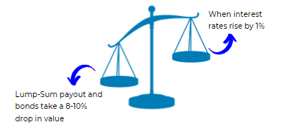
Something else to keep in mind is that current interest rates, as well as your life expectancy at retirement, have an impact on lump-sum payout options of your company's defined benefit pension plans. Lump-sum payouts are typically higher in a low interest rate environment, but be careful because lump-sums decrease in a rising interest rate environment.
Additionally, projected pension lump-sum benefits for active corporate employees will often decrease as an employee ages and their life expectancy decreases. This can potentially be a detriment of continuing to work, so it is important that you run your pension numbers often and thoroughly understand the impact that timing has on your benefit. Other factors such as income needs, need for survivor benefits, and tax liabilities often dictate the decision to take the lump-sum over the annuity option on the pension.

When is the last time you reviewed Halliburton's 401(k) plan account or made any changes to it?
If it’s been a while, you’re not alone. Many plan participants spend little time reviewing their 401(k) investment choices each year.
When you retire from Halliburton, if you have balances in your 401(k) plan, you should receive a distribution notice from the plan. This notice will show the current value that you are eligible to receive from each plan and explain your distribution options. It will also tell you what you need to do to receive your final distribution. Please call The Retirement Group at (800)-900-5867 for more information and we can help you get in front of a specific retirement-focused advisor.
Note: If your employment with Halliburton ends before December 31, whether through resignation or involuntary termination, you may not be eligible for that year's annual contribution unless your employment ended due to retirement, death or disability.
Over half of plan participants admit they don’t have the time, interest or knowledge needed to manage their 401(k) portfolio. But the benefits of getting help goes beyond convenience. Getting help may make it easier to build a diversified portfolio and stick with it through market swings. 

Getting help can be the key to better results across the 401(k) board.
A 2010 Charles Schwab study found several positive outcomes common to those using independent professional advice. They include:
Get help with Halliburton's 401(k) plan investments. Your nest egg will thank you.
While you are employed, Halliburton's plan generally allows in-service withdrawals from after-tax contributions made before 2004 and from rollover accounts, from tax-deferred accounts for a proven financial hardship or while you are performing service in the uniformed services, and from any vested account once you reach age 59½.
Rolling Over Your 401(k)
Under Halliburton's plan, you can borrow a minimum of $1,000 up to the lesser of $50,000 (reduced by your highest outstanding loan balance across company plans in the prior 12 months) or 50% of your vested balance, with only one loan outstanding at a time. Loans carry interest at 1% above the prime rate as of the first business day of the month the loan is made, and must be repaid through payroll deduction within five years, or 10 years for a primary-residence loan.
Borrowing from your 401(k)
Should you? Maybe you lose your job with Halliburton, have a serious health emergency, or face some other reason that you need a lot of cash. Banks make you jump through too many hoops for a personal loan, credit cards charge too much interest, and … suddenly, you start looking at your 401(k) account and doing some quick calculations about pushing your retirement from Halliburton off a few years to make up for taking some money out.
We understand how you feel: It’s your money, and you need it now. But, take a second to see how this could adversely affect your retirement plans after leaving Halliburton.
Consider these facts when deciding if you should borrow from your 401(k). You could:
When you qualify for a distribution you have three options:

How does Net Unrealized Appreciation work?
First an employee must be eligible for a distribution from their qualified company-sponsored plan. Generally at retirement or age 59 1⁄2, the employee takes a 'lump-sum' distribution from the plan, distributing all assets from the plan during a 1 year period. The portion of the plan that is made up of mutual funds and other investments can be rolled into an IRA for further tax deferral. The highly appreciated company stock is then transferred to a non-retirement account.
The tax benefit comes when you transfer the company stock from a tax-deferred account to a taxable account. At this time you apply NUA and you incur an ordinary income tax liability on only the cost basis of your stock. The appreciated value of the stock above its basis is not taxed at the higher ordinary income tax but at the lower long-term capital gains rate, currently 15%. This could mean a potential savings of over 30%.
As a Halliburton employee, you may be interested in understanding NUA from a financial advisor.
When you qualify for a distribution you have three options:
Your retirement assets may consist of several retirement accounts: IRAs, 401(k)s, taxable accounts, and others.
So, what is the most efficient way to take your retirement income after leaving Halliburton?
You may want to consider meeting your income needs in retirement by first drawing down taxable accounts rather than tax-deferred accounts.
This may help your retirement assets with Halliburton last longer as they continue to potentially grow tax deferred.
You will also need to plan to take the required minimum distributions (RMDs) from any company-sponsored retirement plans and traditional or rollover IRA accounts.
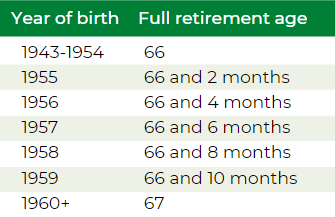
Under current IRS rules, many account owners must begin taking required minimum distributions from these types of accounts at age 73 (age 75 for those born in 1960 or later). SECURE 2.0 reduced the excise tax for each under-distributed RMD dollar from 50% to 25%, with a further reduction possible when corrected timely.
Your first RMD can be delayed until April 1 of the year after you reach RMD age, and if you are still working (and do not own 5% or more of the company), RMDs from your current employer's plan can generally wait until April 1 of the year after you retire. This still-working exception does not apply to IRAs.
Two flexible distribution options for your IRA
When you need to draw on your IRA for income or take your RMDs, you have a few choices. Regardless of what you choose, IRA distributions are subject to income taxes and may be subject to penalties and other conditions if you’re under 59½.
Partial withdrawals: Withdraw any amount from your IRA at any time. If you’re 73 or over, you’ll have to take at least enough from one or more IRAs to meet your annual RMD.
Systematic withdrawal plans: Structure regular, automatic withdrawals from your IRA by choosing the amount and frequency to meet your income needs after retiring from Halliburton. If you’re under 59½, you may be subject to a 10% early withdrawal penalty (unless your withdrawal plan meets Code Section 72(t) rules).
Your tax advisor can help you understand distribution options, determine RMD requirements, calculate RMDs, and set up a systematic withdrawal plan.

HSAs
Health Savings Accounts (HSAs) are often celebrated for their utility in managing healthcare expenses, particularly for those with high-deductible health plans. However, their benefits extend beyond medical cost management, positioning HSAs as a potentially superior retirement savings vehicle compared to traditional retirement plans like 401(k)s, especially after employer matching contributions are maxed out.
Understanding HSAs
HSAs are tax-advantaged accounts designed for individuals with high-deductible health insurance plans. For 2026, the IRS defines high-deductible plans as those with a minimum deductible of $1,700 for individuals and $3,400 for families. HSAs allow pre-tax contributions, tax-free growth of investments, and tax-free withdrawals for qualified medical expenses - making them a triple-tax-advantaged account.
The annual contribution limits for HSAs in 2026 are $4,400 for individuals and $8,750 for families, with an additional $1,000 allowed for those aged 55 and older. Unlike Flexible Spending Accounts (FSAs), HSA funds do not expire at the end of the year; they accumulate and can be carried over indefinitely.
Comparing HSAs to 401(k)s Post-Matching
Once an employer's maximum match in a 401(k) is reached, further contributions yield diminished immediate financial benefits. This is where HSAs can become a strategic complement. While 401(k)s offer tax-deferred growth and tax-deductible contributions, their withdrawals are taxable. HSAs, in contrast, provide tax-free withdrawals for medical expenses, which are a significant portion of retirement costs.
HSA as a Retirement Tool
Post age 65, the HSA flexes its muscles as a robust retirement tool. Funds can be withdrawn for any purpose, subject only to regular income tax if used for non-medical expenses. This flexibility is akin to that of traditional retirement accounts, but with the added advantage of tax-free withdrawals for medical costs - a significant benefit given the rising healthcare expenses in retirement.
Furthermore, HSAs do not have Required Minimum Distributions (RMDs), unlike 401(k)s and Traditional IRAs, offering more control over tax planning in retirement. This makes HSAs particularly advantageous for those who might not need to tap into their savings immediately at retirement or who want to manage their taxable income.
Investment Strategy for HSAs
Initially, it's prudent to invest conservatively within an HSA, focusing on maintaining sufficient liquid funds to cover near-term deductible and other out-of-pocket medical expenses. However, once a financial cushion is established, treating the HSA like a retirement account by investing in a diversified mix of stocks and bonds can help enhance the account's growth potential over the long term.
Utilizing HSAs in Retirement
In retirement, HSAs can cover a range of expenses:
Conclusion
In summary, HSAs offer unique advantages that can make them a superior option for retirement savings, particularly once you are contributing enough to receive the full 401(k) match. Their flexibility in fund usage, coupled with tax advantages, makes HSAs an essential component of a comprehensive retirement strategy. By strategically managing contributions and withdrawals, individuals can work toward stronger financial health in retirement and help preserve both their medical and financial well-being.
Company Benefits Annual Enrollment
Annual enrollment for Halliburton's benefits usually occurs each fall.
Before it begins, you will be mailed enrollment materials and an upfront confirmation statement reflecting your benefit coverage to the address on file. You’ll find enrollment instructions and information about your benefit options from Halliburton and contribution amounts. You will have the option to keep the benefit coverage shown on your upfront confirmation statement or select benefit options offered by Halliburton that better support your needs. You may be able to choose to enroll in eBenefits and receive this information via email instead.
Next Steps:
Things to keep in mind :
Short-Term & Long-Term Disability
Short-Term: Depending on your plan, you may have access to short-term disability (STD) benefits through Halliburton.
Long-Term: Your plan's long-term disability (LTD) benefits are designed to provide you with income if you are absent from Halliburton for six consecutive months or longer due to an eligible illness or injury.

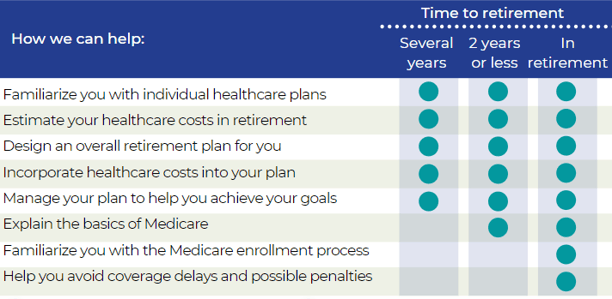
Halliburton sponsors a retiree medical plan, the Halliburton Energy Services, Inc. Retiree Medical Benefits Plan. Its 2025 Form 5500 reported 220 participants at the end of 2025, down from 246 at the start of the year. Check with Halliburton's benefits center on whether you are eligible for it.

Divorce doesn’t disqualify you from survivor benefits. You can claim a divorced spouse’s survivor benefit if the following are true:
In the process of divorcing?
If your divorce isn’t final before your retirement date from Halliburton, you’re still considered married. You have two options:
Source: The Retirement Group, “Retirement Plans - Benefits and Savings,” U.S. Department of Labor; “Generating Income That Will Last Throughout Retirement,” Fidelity
In the unfortunate event that you aren’t able to collect your benefits from your company, your survivor will be responsible for taking action.
What your survivor needs to do:
If you have a joint pension:
If your survivor has medical coverage through your company:
While you may be ready for some rest and relaxation, without the stress and schedule of your full-time career with Halliburton, it may make sense to you financially, and emotionally, to continue to work.
https://www.irs.gov/newsroom/irs-provides-tax-inflation-adjustments-for-tax-year-2022
https://news.yahoo.com/taxes-2022-important-changes-to-know-164333287.html
https://www.nerdwallet.com/article/taxes/federal-income-tax-brackets
https://www.the-sun.com/money/4490094/key-tax-changes-for-2022/
https://www.bankrate.com/taxes/child-tax-credit-2022-what-to-know/