New Update: Rising Oil Costs are Affecting Retirement Plans. Will you be impacted?
Retirement Guide for Northrop Grumman Employees Tax Rates & Inflation



Barron’s: Awarded on 9/12/2025 (Mega RIA) for 6/30/24-6/30/25. Paid for logo use. Forbes: Awarded 10/1/25 for 3/31/24-3/31/25. Paid for logo use. USA Today: Awarded 4/15/26 for the five-year period ending January 2026. Paid for logo use.

Oil market turbulence continues to ripple through the broader economy, with a closing futures price of $91.26 for WTI and $102.70 for Brent as of October 02, 2026 and annualized volatility near 80%. Jet fuel costs, petrochemical composite materials, and fixed-price contract structures mean elevated crude prices create margin pressure across the aerospace supply chain. For Northrop Grumman employees making tax planning decisions, oil-driven market volatility can create both challenges and opportunities around income recognition timing, gain harvesting, and strategic loss realization. Professional guidance can help you navigate the indirect effects of oil volatility on your retirement planning and ensure your strategy accounts for these dynamics.
Source: Yahoo Finance
Author:

Nicole Webb - Senior Vice President, Financial Advisor
In our thorough retirement guide for Northrop Grumman employees, we discuss numerous variables to consider when determining whether to retire from Northrop. Some of these issues are healthcare and benefit changes, interest rates, the new tax rates, inflation, and many others. Keep in mind that we are not linked with Northrop, and we recommend contacting your corporate benefits department for further information.
Northrop Grumman faced a significant setback as Boeing won the Navy's next-generation F/A-XX fighter jet competition, a major contract loss that triggered analyst downgrades and weakness in NOC's stock performance. RBC Capital downgraded Northrop to Sector Perform with a $525 price target, citing the competitive loss to Boeing's platform, which leverages established carrier-based and drone capabilities. On a positive note, Northrop secured a U.S. Army contract for XRC ramjet propulsion development, providing a diversifying revenue stream beyond the Navy setback. For retirement investors holding Northrop in their portfolios, the near-term volatility reflects execution risk in major defense competitions, though the company's broader portfolio of government contracts continues to support long-term stability.
Source: Currents API / Google News

Individuals must be aware of any new changes implemented by the IRS. The key elements influencing employees will be the following:
-
The standard deduction for will rise to $16,100 for single filers and married couples filing separately, $32,200 for joint filers, and $24,150 for heads of household.
-
Taxpayers over the age of 65 or blind can increase their standard deduction by $1,550. If you are not married or have no surviving spouse, the payment increases to $1,950.
Retirement account contributions: Contributing to your employer's 401k plan can dramatically reduce your tax burden, and the amount you can save has increased for . Individuals' 401(k) contributions in will climb to $24,500, up from $24,500 in . The catch-up contribution ceiling for employees 50 and older will rise to $7,500.
As a taxpayer employed by a corporation, you should be aware of the following key changes to the Earned Income Tax Credit (EITC):
-
for the current tax year the maximum Earned Income Tax Credit amount is $7,830 for qualifying taxpayers with three or more qualifying children, up from $7,430 in .
-
Married taxpayers filing separately may qualify: If you meet other conditions, you can claim the EITC as a married couple filing separately. This was unavailable in earlier years.
Deduction for cash charitable contributions: The special deduction, which enabled single non-itemizers to deduct up to $300 and married filing jointly couples to deduct $600 in cash donations to qualifying charities, has expired.
Child Tax Credit Changes:
-
The highest tax credit per qualified child is $2,000 for children under five and $3,000 for children aged six to seventeen. Furthermore, you cannot obtain a portion of the credit in advance, as was the case in .
-
As a parent or guardian, you are eligible for the Child Tax Credit if your adjusted gross income is less than $200,000 when filing alone or less than $400,000 when filing jointly with a spouse.
-
Individuals with a tax bill that is less than the credit amount are eligible for a 70% partial refund.
Tax Brackets

Inflation decreases purchasing power over time because the same basket of products becomes more expensive as prices rise. To maintain your current quality of life after leaving your business, you must account for rising expenditures in your retirement plan. While the Federal Reserve aims for a 2% inflation rate each year, in the rate jumped to 4.9%, a significant increase from 1.4% in . While overall expenses have risen considerably, there are several key areas to consider if you are nearing or in retirement from your job, such as healthcare.
It is critical to consider all of these aspects when developing your overall plan for retirement from your company.
*Source: IRS.gov, Yahoo, Bankrate
Recent Layoff Announcements & Other Northrop Grumman News
Restructuring and Layoffs: Northrop Grumman is laying off around 1,500 employees as part of a restructuring plan to improve operational efficiency (Source: Defense News). Strategic Adjustments: The company is focusing on its core defense and aerospace businesses. Financial Performance: Northrop Grumman reported a 6% increase in net sales for Q4 , driven by strong demand for its defense products (Source: Northrop Grumman).
Blogs You May Enjoy:





Retirement planning is a verb. And consistent action must be taken whether you’re 20 or 60.
The truth is that most Americans don’t know how much to save or the amount of income they’ll need.
No matter where you stand in the planning process, or your current age, we hope this guide gives you a good overview of the steps to take and resources that help you simplify your transition from Northrop Grumman into retirement and get the most from your benefits.
You know you need to be saving and investing, especially since time is on your side the sooner you start, but you don’t have the time or expertise to know if you’re building retirement savings that can last after leaving Northrop Grumman.
'A separate study by Russell Investments, a large money management firm, came to a similar conclusion . Russell estimates a good financial advisor can increase investor returns by 3.75 percent.'
Source: Is it Worth the Money to Hire a Financial Advisor?, the balance,
Starting to save as early as possible is critical. With time on your side, compounding can have a big impact on your future savings. And, after you've started, it's critical to keep increasing and maximizing your contributions to your 401(k).
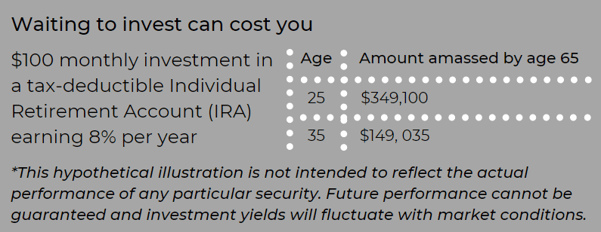
When you invest in your company's retirement plan, you can potentially increase your wealth by 79% at age 65 over the course of 20 years.
*Source: Bridging the Gap Between 401(k) Sponsors and Participants, T.Rowe Price,
Saving for retirement vs college is a basic planning issue. Most financial advisors will advise you that retirement from your employer should be your main priority because your child can usually receive financial aid, however you will be on your own to fund your retirement.
We always base our retirement investment recommendations on your specific financial circumstances and aspirations. Consider investing at least 10% of your earnings for retirement in your 30s and 40s.
As you enter your 50s and 60s, you should be at the pinnacle of your earning potential, with some of your major expenses, such as a mortgage or childrearing, behind you or soon to be behind you. This is an excellent moment to think about whether you can increase your retirement savings goal to 20% or more of your income. For many people, this could be their only chance to save money.
Workers over the age of 50 can invest up to $24,500 in their retirement plan/401(k) in , and after this limit is reached, they can contribute an additional $8,000 in catch-up contributions for a total yearly contribution of $30,500. Annually, these restrictions are increased to reflect inflation.
Why are 401(k)s and matching contributions so popular?
These retirement savings vehicles allow you to take advantage of three major benefits:
-
Compound growth prospects (as described above)
-
Tax-saving opportunities
-
Matching contributions
Matching contributions are exactly what they sound like: your company matches your 401(k) contributions with money from the company. If your company matches, the company money will normally match up to a specified percentage of the amount you contribute.
Unfortunately, many consumers do not take advantage of their business's matching contributions because they do not contribute the sufficient amount to obtain the entire corporate match.
According to Bank of America's " Financial Life Benefit Impact Report," despite 58% of eligible employees enrolling in a 401(k) plan, 61% contributed less than $5,000 this year.
The study also discovered that fewer than one in every ten members' contributions exceeded the IRS Section 402(g) optional deferral limit, which is $24,500 in .
A Financial Engines study titled "Missing Out: How Much Employer 401(k) Matching Contributions Do Employees Leave on the Table?" discovered that individuals who do not maximize their business match typically leave $1,336 of extra retirement money on the table each year.
For example, if your business matches up to 3% of your plan contributions and you only contribute 2% of your salary, you will not receive the entire company match. By just increasing your contribution by 1%, your firm now matches the entire 3% of your donations, for a total combined contribution of 6%. This ensures that you do not leave money on the table.

Whether you're changing jobs or retiring, deciding what to do with your hard-earned retirement funds can be challenging. A company-sponsored plan, such as a pension or 401(k), may account for the majority of your retirement assets, but how much do you actually understand about it and how it works?
There appear to be an infinite number of restrictions that differ from one retirement plan to the next, including early withdrawal offers, interest rate affects, age penalties, and intricate tax implications.
Increasing your investment balance and lowering taxes are the keys to a successful retirement plan spending strategy. At The Retirement Group, we can explain how your company's 401(k) fits into your entire financial picture and how to make it work for you.
'Getting help and leveraging the financial planning tools and resources your company
makes available can help you understand whether you are on track, or need to
make adjustments to meet your long-term retirement goals...'
Northrop Grumman Pension Program
Northrop Grumman's Pension Program is simply one part of an employee's entire retirement savings plan. This program allows eligible employees to earn credit toward a pension benefit that will be paid out after they leave Northrop Grumman and meet the qualifying retirement age. The sort of credit an employee receives depends on the pension plan in which they participate.
Generally, employees who were employed on or after July 1, , are not eligible to participate in the Northrop Grumman Pension program. Instead, they may be entitled to receive an extra employer contribution from Northrop Grumman Savings plan.
Highlights of the Northrop Grumman Pension Program

Choosing the best moment to retire is an essential decision. You should carefully analyze various aspects, including wages, service, and age, and how these effect your pension payout. You must also give yourself plenty of time to get your pension estimate and plan your retirement.
Applying for Your Northrop Grumman Retirement Benefits
To request your retirement kit, contact the Northrop Grumman Benefits Center (NGBC) at least 30 days (but no more than 90 days) before your planned retirement date. If you qualify for a pension benefit, your pension kit will include an estimate of your benefits. Information about retiree medical coverage, if relevant, will be supplied individually.


Your Pension Plan


Part A Calculation

Part B/C Calculation & Space and Mission Systems Pension Plan


Part C Calculation


Part D Calculation - Cover Letter Rule of 9

Payment Options

Next steps:
-
Determine whether you should receive the NGC Pension as a lump sum or an annuity.
-
How do interest rates influence your decision?
-
Use the "RetireKit" to better understand cash flow, interest rates, and which pension choice is best for you in retirement.
-
As you approach your retirement date, contact an NGC-focused advisor at The Retirement Group and study the appropriate SPD Summary to begin your retirement planning.
-
NGC will require you to give proof of birth, marriage, divorce, Social Security number, and other information for yourself and your spouse/legally recognized partner.
-
NGC offers Beneficiary Designation online, which allows you to alter your beneficiary designations, if appropriate to your pension program. Please read your SPD for additional information.
Lump-Sum vs. Annuity
Retirees who are qualified for a pension are frequently given the option of receiving their pension payments throughout life or receiving a lump-sum payment all at once. The lump amount represents the equivalent present value of the monthly pension income stream, with the intention of taking the money (rolling it over to an IRA), investing it, and generating your own cash flow through methodical withdrawals throughout your retirement years.
The monthly pension has the advantage of being guaranteed to continue indefinitely. Thus, whether you live for ten, twenty, thirty, or more years after retiring from your firm, you are not at risk of outliving your monthly pension.
The main disadvantage of the monthly pension is the early and untimely death of the retiree and joint annuitant. This frequently results in a reduced payout or the pension being terminated entirely upon death. The other disadvantage is that, unlike Social Security, employer pensions seldom include a COLA (Cost of Living Allowance). As a result, if the dollar value of the monthly pension remains constant throughout retirement, it will lose purchasing power as inflation increases.
 In contrast, choosing the lump-sum option allows you to invest, earn higher growth, and perhaps produce even more retirement income flow. Furthermore, if something happens to you, any unused account balance will be available to your surviving spouse or heirs. However, if you fail to invest the funds for sufficient development, the money may run out entirely, and you may regret not taking advantage of the pension's "income for life" guarantee.
Finally, the "risk" assessment that should be performed to determine whether or not you should choose the lump sum or the guaranteed lifetime income that your employer pension provides is determined by the type of return required to match the annuity payments. After all, if a 1% to 2% return on the lump-sum is all that is required to generate the same monthly pension cash flow stream, the risk of outliving the lump-sum is reduced. However, if the pension payments can only be replaced with a higher and more risky rate of return, there is a bigger danger that those gains will not materialize and you would run out of funds.
Interest Rates and Life Expectancy
Many defined benefit plans, such as the NGC pension plan, give current and future retirees a lump sum payment or a monthly pension benefit. These plans may have billions of dollars in unfunded pension liabilities, and in order to remove the burden from their books, they give a lump payout.
Depending on life expectancy, the first lump sum is usually smaller than recurring pension payments throughout a typical retirement period. Most people who choose the lump-sum plan, however, invest the majority of the income because the assets aren't needed right away after retirement.
Another thing to bear in mind is that current interest rates, as well as your life expectancy at retirement, affect annuity payment options in defined benefit pension plans. Lump sum distributions are normally higher in a low interest rate environment; however, lump sums fall in a rising interest rate environment.
Furthermore, predicted pension lump sum payments for current employees frequently drop as they age and their life expectancy declines. This might possibly be detrimental to continuing to work, thus it is critical that you run your pension statistics frequently and clearly grasp the timing difficulties. Other criteria, such as income requirements, the necessity for survivor benefits, and tax liabilities, frequently influence the decision to select the lump-sum over the annuity option on the pension.

401(k) Savings Plan
Employees are advised to immediately enroll in a 401(k) savings plan. Northrop Grumman's 401(k) plan allows employees to contribute pre-tax, Roth 401(k), and after-tax dollars. Additionally, there are Company-matching contributions equal to:
* 100% of the first 4% of pre-tax, Roth 401(k), and after-tax contributions; and
* 50 percent of the subsequent 4% of employee contributions
You can invest before tax and/or after tax (regular or Roth) and select from a variety of investment options with varied levels of risk. You can also transfer pre-tax and Roth contributions from other qualifying plans.
Vesting
As a participant, you become eligible for the employer match after three years of service. If you leave your job after fewer than three years, you lose the corporate match but keep the rest.
Note: If you contribute at least 8% of your earnings, you will receive a 6% corporate match.
If you have 401(k) plan balances at the time of retirement, you will receive a Participant Distribution Notice in the mail. This notification will outline the current value of each plan and explain your distribution alternatives. It will also tell you what steps you need to do to obtain your final allocation. Please call The Retirement Group at (800)-900-5867 for additional information, and we will put you in touch with a retirement-focused advisor.
Next Step:
- Watch for your Participant Distribution Notice and Special Tax Notice Regarding Plan Payments. These notices will help explain your options and what the federal tax implications may be for your vested account balance.
- ' What has Worked in Investing ' & ' 8 Tenets when picking a Mutual Fund '.
- To learn about your distribution options, call The Retirement Group at (800)-900-5867. Click our e-book for more information on ' Rollover Strategies for 401(k)s '. Use the Online Beneficiary Designation to make updates to your beneficiary designations, if needed.
Note : If you voluntarily terminate your employment from Northrop Grumman, you may not be eligible to receive the annual contribution.

In-Service Withdrawals
In general, you can withdraw funds from your account while still employed with your firm, subject to the conditions outlined below.
Certain withdrawals are subject to standard federal income tax, and if you're under age 59½, you may also face an additional 10% penalty tax. You can check if you're qualified for a withdrawal and then request one online or by phoning your company's Benefits Center.
Rolling Over Your 401(K)
An in-service dividend can be rolled over to an IRA if the plan participant is under 72 years old. A straight rollover avoids both the 10% early withdrawal penalty and the necessary 20% tax withholding. More information, including potential rollover and withdrawal limits, can be found in your company's plan summary.
Because a withdrawal permanently decreases your retirement savings and is taxed, you should always consider obtaining a loan from the plan rather than withdrawing to satisfy your financial needs. Loans, unlike withdrawals, must be repaid and are tax-free (unless you fail to repay them). In other situations, such as hardship withdrawals, you are not permitted to make a withdrawal unless you have taken out the maximum loan available under the employer plan.
You should also be aware that your company's plan administrator reserves the right to change the regulations governing withdrawals at any moment, and may further restrict or limit the availability of withdrawals for administrative or other purposes. All plan participants shall be made aware of any such limits, which apply equally to all business workers.
Borrowing From Your 401(k)
Should you do it? Perhaps you lose your job with the company you work for, have a significant health issue, or have another cause why you require a large sum of money. Banks require excessive paperwork for personal loans, credit cards have high interest rates, and you may consider deferring retirement from your firm to compensate for taking money out.
We understand how you feel: this is your money, and you need it right now. However, consider how this may effect your retirement plans once you leave your employer.
Consider these facts while deciding whether you should borrow from your 401(k). You could do:
-
You will lose the development potential of the money you borrowed.
-
If you leave your company, you will be responsible for repayment and tax concerns.
-
Repayment and tax complications may arise if you leave your organization.
Net Unrealized Appreciation (NUA)
When you qualify for a distribution, you have three choices:
-
Roll over your eligible plan to an IRA and continue to defer taxes.
-
Take a distribution and pay regular income taxes on the entire amount.
-
Take advantage of NUA and profit from a more favorable tax structure for gains.
How does Net Unrealized Appreciation Work?
First, an employee must be eligible for a distribution from a qualified company-sponsored plan. At retirement or age 59 1⁄2, employees often get a 'lump-sum' distribution from their plan, which distributes all assets over a year period. The portion of the plan that consists of mutual funds and other investments can be transferred to an IRA for additional tax deferral. The highly appreciated firm shares is subsequently moved into a non-retirement account.
The tax benefit occurs when you transfer business stock from a tax-deferred account to a taxable account. At this point, you apply NUA and pay ordinary income tax on the cost basis of your shares. The stock's appreciated value above its basis is taxed at the lower long-term capital gains rate, which is now 15%, rather than the higher ordinary income tax. This could result in savings of over 30%.
You may want to learn more about NUA by scheduling a complimentary one-on-one consultation with a financial advisor from The Retirement Group.
IRA Withdrawal
When you qualify for a distribution, you will have three options:
Your retirement assets could include IRAs, 401(k)s, taxable accounts, and others.
So, what is the best approach to withdraw your retirement income after leaving your company?
Consider fulfilling your retirement income demands by withdrawing from taxable assets rather than tax-deferred investments.
This may help your company's retirement assets last longer by allowing them to grow tax-deferred.
You should also prepare to take the required minimum distributions (RMDs) from any company-sponsored retirement plans, as well as traditional or rollover IRA accounts.
This is due to IRS guidelines for , which state that you must begin taking distributions from these types of accounts when you reach age 73. Beginning in , the excise tax on each dollar of under-distributed RMD will be decreased by 50% to 25%.
There is new legislation that allows account owners to postpone their first RMD until April 1 of the calendar year in which they reach age 73 or, in a company retirement plan, retire.
Two flexible distribution alternatives for your IRA
When it comes to drawing on your IRA for income or taking RMDs, you have a few options. IRA distributions are taxed and may have penalties for those under 59½.
Partial withdrawals: You may remove any amount from your IRA at any time. If you're 73 or older, you must withdraw money from one or more IRAs to pay your annual RMD.
Systematic withdrawal plans: Set up regular, automatic withdrawals from your IRA based on your income needs once you retire from your company. If you are under 59½, you may face a 10% early withdrawal penalty (unless your withdrawal plan meets Code Section 72(t) criteria).
Your tax advisor can assist you in understanding distribution alternatives, determining RMD obligations, calculating RMDs, and establishing a systematic withdrawal strategy.

HSA's
Health Savings Accounts (HSAs) are frequently praised for their usefulness in controlling healthcare costs, especially for people with high-deductible health plans. However, its advantages go beyond medical cost management, placing HSAs as a potentially superior retirement savings vehicle compared to typical retirement plans such as 401(k)s, particularly after employer matching contributions are exhausted.
Understanding HSA
HSAs are tax-advantaged accounts established for people who have high-deductible health insurance policies. For , the IRS defines high-deductible plans as those having a deductible of $1,600 for individuals and $3,200 for families. HSAs offer pre-tax contributions, tax-free investment growth, and tax-free withdrawals for qualified medical costs, making them a triple-tax-advantaged account.
The annual contribution limits for HSAs in are $4,400 for individuals and $8,750 for families, with an additional $1,000 allowed for those 55 and older. Unlike Flexible Spending Accounts (FSAs), Health Savings Account (HSA) money build and can be carried over indefinitely.
Comparing HSAs to 401(k)s After Matching
Once an employer's maximum match in a 401(k) is reached, additional contributions provide less immediate financial benefit. This is where HSAs can play a strategic role. While 401(k)s provide tax-deferred growth and tax-deductible contributions, withdrawals are taxable. In contrast, HSAs allow for tax-free withdrawals for medical expenses, which account for a large amount of retirement costs.
HSA is a Retirement Tool
After age 65, the HSA proves itself as a powerful retirement tool. Funds can be taken for any reason, with the exception of non-medical expenses, for which standard income tax applies. This flexibility is similar to that of regular retirement plans, but it also includes tax-free withdrawals for medical bills, which is a substantial benefit given escalating senior healthcare costs.
Furthermore, unlike 401(k)s and Traditional IRAs, HSAs do not require Required Minimum Distributions (RMDs), giving you more discretion over tax planning in retirement. This makes HSAs especially appealing to those who may not need to withdraw their funds immediately at retirement or who want to reduce their taxable income.
Investment Strategy for HSA
Initially, it's best to invest conservatively in an HSA, focusing on ensuring that there are enough liquid funds to cover the near-term deductible and other out-of-pocket medical bills. However, if a financial cushion has been developed, treating the HSA as a retirement account and investing in a diverse mix of stocks and bonds can dramatically increase the account's long-term growth potential.
Using HSAs in Retirement
In retirement, HSAs can cover a range of expenses:
-
Healthcare bills Before Medicare: HSAs can pay for healthcare bills to bridge you to Medicare.
-
Healthcare Costs After Medicare: HSAs can be used to pay for Medicare premiums as well as out-of-pocket medical expenses, like as dental and vision care, which are frequently excluded from Medicare.
-
Long-term Care: Funds can be used to cover approved long-term care services as well as insurance payments.
-
Non-medical Expenses: After the age of 65, HSA funds can be used for non-medical expenses without penalty, while withdrawals are subject to income tax.
Conclusion
In conclusion, HSAs have distinct features that can make them a better choice for retirement savings, especially once the benefits of 401(k) matching have been utilized. HSAs are an important part of a comprehensive retirement strategy because of their flexibility in fund usage and tax advantages. Individuals can maximize their financial health in retirement by properly managing their contributions and withdrawals, ensuring both medical and financial security.
What Happens If Your Employment Ends
Your life insurance coverage, as well as any optional coverage you acquire for your spouse/domestic partner and/or children, expires on the date your employment with your firm ends, unless it is due to disability. If you die within 31 days of your company's termination date, your beneficiary receives benefits for both your basic life insurance and any supplemental life insurance coverage you choose.
Note:
-
You may be able to change your life insurance to an individual policy or choose portability for any optional coverage.
-
If you cease paying additional contributions, your coverage will expire.
-
If you are at least 65 years old and pay for additional life insurance, the insurance company should send you literature in the mail explaining your options.
-
Make care to notify your beneficiaries. For more information, consult your company's sales and profit statement.
Beneficiary Designations
As part of your retirement and estate planning, you should designate someone to receive the proceeds of your benefit programs in the event that you die. This is how your employer will choose who should receive your ultimate compensation and benefits. This includes life insurance payouts, as well as any pension or savings balances you may have.
Next step:
- When you retire, make sure to update your beneficiaries and the Beneficiary Designation form to reflect life events such as death, marriage, divorce, childbirth, adoption, and so on.

Understanding and claiming Social Security can be challenging for many retirees, but determining the best ways to do so is critical to your retirement income planning. Social Security benefits are not intended to be the primary source of retirement income, but rather to supplement your total withdrawal strategy.
Knowing the fundamentals of Social Security and applying that knowledge to your advantage will help you collect the most benefit.
It is your duty to enroll in Medicare Parts A and B when you first become eligible, and you must remain enrolled to receive coverage for Medicare-eligible expenses. This also applies to your dependents who are qualified for Medicare benefits.
You should understand how your retiree medical plan selections and Medicare eligibility affect your plan alternatives. Before you resign from your employer, contact the Social Security Administration at 800-772-1213, your local Social Security Office, or ssa.gov.
They can assist you in determining your eligibility, enrolling you and/or your eligible dependents in Medicare, and providing information about other government programs. Please call us if you need additional information about Social Security.

Before you depart from your employer, double-check your Social Security benefits status. Contact the Social Security Administration in the United States, your local office, or go to ssa.gov.
Are you already or soon to be eligible for Medicare?
If you or your dependents become eligible for Medicare after leaving your telecom industry company, Medicare will normally become your primary coverage as soon as they are. This has an impact on the medical benefits given by the firm.
When you initially become Medicare-eligible, you and your dependents must enroll in Parts A and B. Medical and MH/SA benefits payable under the company's sponsored plan will be lowered by the amounts Medicare Parts A and B would have paid regardless of whether you enrolled in them.
Please see your company's summary plan description for more information on benefit coordination.
If you or an eligible-dependant do not enroll in Medicare Parts A and B, your provider may bill you for amounts not covered by Medicare or your company's medical plan. This increases your out-of-pocket spending dramatically.

According to the Employee Benefit Research Institute (EBRI), Medicare only covers roughly 60% of an individual's medical expenses. This indicates that a 65-year-old couple with typical prescription-drug expenses for their age will require $259,000 in savings to cover 90% of their healthcare costs. A single man will need $124,000, whereas a single woman will need $140,000 because to her longer life expectancy.
Check Northrop Grumman's plan summary to see if you’re eligible to enroll in Medicare Parts A and B.

If you become Medicare-eligible for reasons other than age, you must contact Northrop Grumman’s benefit center about your status.

28% of couples over the age of 53 will not experience the happily ever after and until death do us part. Most couples save for decades, expecting they would retire together. Following a divorce, they must face the expenses of a pre- or post-retirement lifestyle while only having half of their savings.
If you're divorced or in the process of divorce, your ex-spouse(s) may be interested in a portion of your company's retirement benefits. Before you may begin your pension—and for each former spouse who may be interested—you must submit your firm with the necessary documentation:
-
A copy of the court-filed Judgment of Dissolution or Judgment of Divorce, together with any Marital Settlement Agreement (MSA)
-
A copy of the court's Qualified Domestic Relations Order (QDRO)
Regardless of how long or brief your marriage was, you must submit this evidence to your company's online pension center. *Source: The Retirement Group, "Retirement Plans - Benefits and Savings," U.S.
You can apply for a divorced spouse's benefit if the following conditions are met:
You're at least 62 years old.
You were married for at least ten years before the divorce.
You are currently unmarried.
Your ex-spouse is eligible for Social Security benefits.
Your individual Social Security benefit amount is lower than your spousal benefit amount, which is one-half of your ex's full benefit amount if claimed at Full Retirement Age (FRA).
Unlike a married pair, your ex-spouse does not need to have filed for Social Security before you may apply for your divorced spouse's benefit; however, this only applies if you've been divorced for at least two years and your ex is at least 62 years old. If your divorce occurred less than two years ago, your ex must be receiving benefits before you can register as a divorced spouse.
Unlike a married couple, you do not have to wait for your ex-spouse to file for Social Security before applying for your divorced spouse's benefit.
Divorce does not disqualify you for survivor benefits. You can claim a divorced spouse's survivor benefit if the following apply:
-
Your ex-spouse has died.
-
You are at least sixty years old.
-
You were married for at least ten years before the divorce.
-
You are single (or remarried after turning 60).
Are you going through a divorce?
If your divorce is not finalized by the time you retire from your company, you are still considered married. You have two choices:
Retire from your company before your divorce is finalized and opt for a combined pension of at least 50% with your spouse — or obtain your spouse's signed, notarized approval to a different election or lump amount.
Defer your retirement from your company until your divorce is finalized and you can supply the necessary divorce documentation*.
If you're weighing inflation and your money, Northrop Grumman's benefits structure is the piece most employees underestimate. The retirement plan details that seem like fine print today become the numbers that define your income later.
Employees have access to retirement savings programs with company contributions, along with healthcare benefits that complement their overall compensation package. Alongside those retirement benefits, your healthcare coverage plays a bigger role than most employees realize. What you're paying for medical, dental, and vision coverage now, and what those costs look like in retirement, directly affects how far your savings will stretch when it comes to inflation and your money.
Whether you're five years from retirement or fifteen, understanding how Northrop Grumman's benefits interact with your broader financial plan is worth the effort. For inflation and your money, that understanding is the difference between a guess and a strategy.
Source: The Retirement Group, “Retirement Plans - Benefits and Savings,” U.S.
What your survivor should do:
-
Report your death. Your spouse, family member, or friend should contact your company's benefits service center as quickly as possible to report your death.
-
Receive life insurance benefits. To get life insurance benefits, your spouse or other designated beneficiary must contact your company's benefits service center.
If you have a shared pension.
-
Start making joint pension contributions. The joint pension is not automatic. To begin receiving joint pension payments, your joint pensioner must complete and return the papers provided by your company's pension center.
-
Prepare financially to pay living expenditures. Your spouse will need to have enough funds to cover at least one month between the end of your company's pension payments and the start of his or her own pension payments.
-
Decide whether or not to keep your medical coverage.
-
If your survivor is enrolled as a dependent in your company's retiree medical coverage when you die, he or she must decide whether to continue it. Survivors must pay the entire monthly cost.

While you may be ready for some leisure and relaxation away from the stress and schedule of your full-time job with your firm, it may make financial and emotional sense for you to continue working.
Financial benefits of working
Make up for decreased value of savings or investments. Low interest rates make it great for lump sums but harder for generating portfolio income. Some people continue to work to make up for poor performance of their savings and investments.
Maybe you took an offer from Northrop Grumman and left earlier than you wanted with less retirement savings than you needed. Instead of drawing down savings, you may decide to work a little longer to pay for extras you’ve always denied yourself in the past.
Meet financial requirements of day-to-day living. Expenses can increase during your retirement from Northrop Grumman and working can be a logical and effective solution. You might choose to continue working in order to keep your insurance or other benefits — many employers offer free to low cost health insurance for part-time workers.
Emotional benefits of working
You might find yourself with very tempting job opportunities at a time when you thought you’d be withdrawing from the workforce.
Staying active and involved. Retaining employment after Northrop Grumman, even if it’s just part-time, can be a great way to use the skills you’ve worked so hard to build over the years and keep up with friends and colleagues.
Enjoying yourself at work. Just because the government has set a retirement age with its Social Security program doesn’t mean you have to schedule your own life that way. Many people genuinely enjoy their employment and continue working because their jobs enrich their lives.
Northrop Grumman employees interested in planning their retirement may be interested in live webinars hosted by experienced financial advisors. Click here to register for our upcoming webinars for Northrop Grumman employees.

https://www.irs.gov/newsroom/irs-provides-tax-inflation-adjustments-for-tax-year-
https://news.yahoo.com/taxes--important-changes-to-know-164333287.html
https://www.nerdwallet.com/article/taxes/federal-income-tax-brackets
https://www.bankrate.com/taxes/child-tax-credit--what-to-know/
How can Northrop Grumman employees effectively maximize their retirement income, and what role do pension plans and personal investments play in this strategy? It's important for employees to understand how components like the Pension Plan Benefits, Savings Plan Benefits, and Social Security Benefits collectively provide a robust retirement framework. This question invites a detailed exploration of how Northrop Grumman's various programs interact, and what actions employees can take to ensure they are optimizing their retirement savings.
Maximizing Retirement Income at Northrop Grumman: Northrop Grumman employees can maximize their retirement income by effectively leveraging the combination of Pension Plan Benefits, Savings Plan Benefits, Social Security Benefits, and Personal Savings and Investments. Each component plays a crucial role: the pension plan provides a defined benefit based on salary and years of service, the savings plan offers a vehicle for tax-advantaged growth through employee and employer contributions, and social security offers a baseline of income adjusted for inflation. Employees should aim to maximize their contributions, particularly to the 401(k) plan, and manage their investments according to their individual retirement timelines and risk tolerance.
What are the different types of retirement benefits available to Northrop Grumman employees, and how do these benefits impact retirement planning? Employees should be aware of the distinctions between defined benefit plans, like the Heritage TRW, and defined contribution plans, such as the 401(k) Savings Plan. This question will allow an in-depth examination of how these benefits function and their significance in the context of Northrop Grumman's overall compensation structure.
Types of Retirement Benefits: Northrop Grumman offers both defined benefit and defined contribution retirement plans. The Heritage TRW Pension Plan, a defined benefit plan, bases pensions on final average earnings and years of service. The 401(k) Savings Plan, a defined contribution plan, allows employees to save and invest with tax advantages, with contributions from both the employee and employer. Understanding these plans' structures and benefits is essential for employees to plan effectively for retirement.
In what ways have recent changes to the Northrop Grumman Pension Program affected employees who are planning to retire in the near future? Understanding the specifics of benefit adjustments or freezing final average earnings will be pivotal for employees' retirement planning. This inquiry will encourage discussion around how these changes influence both current and future retirees regarding their readiness for retirement and their financial planning.
Impact of Recent Changes to Pension Program: Recent changes to the Northrop Grumman Pension Program, such as the freezing of the final average earnings calculation as of December 31, 2014, affect employees planning to retire soon. These changes may alter the expected retirement benefits for some employees, making it crucial for near-retirees to reassess their projected pension benefits under the new rules and plan accordingly to meet their retirement goals.
How do Northrop Grumman employees qualify for early retirement under the current pension plan, and what benefits can they expect? This question should delve into the eligibility criteria for early retirement based on age and years of service, as well as highlight the benefits associated with this option. It provides an opportunity to explore the trade-offs and advantages of opting for early retirement versus working longer.
Early Retirement Qualifications and Benefits: Northrop Grumman employees can qualify for early retirement if they are at least 55 years old with 10 years of vesting service, receiving benefits reduced based on early retirement factors. Understanding these factors and the impact on the retirement benefits can help employees decide the best age to retire to maximize their pension benefits while considering their personal and financial circumstances.
What essential steps should Northrop Grumman employees take to prepare for retirement, including understanding their pension plan and social security benefits? This question can explore the various resources available, such as tools and calculators provided by Northrop Grumman, and the importance of proactive planning. Employees should consider how their decisions today will influence their retirement lifestyle, including the necessity of accumulating both pension and social security benefits.
Preparation Steps for Retirement: Employees should take proactive steps such as utilizing Northrop Grumman’s retirement calculators, attending planning seminars, and consulting with financial advisors available through the Northrop Grumman Benefits Center. It's also important for employees to understand how their pension benefits interact with Social Security and personal savings to create a comprehensive retirement strategy.
What options do Northrop Grumman employees have for managing their savings after retirement, and how can they choose the best strategy for their individual needs? Discussion here can encompass the different methods for drawing down retirement accounts, the importance of balancing withdrawals with ongoing expenses, and considerations for managing longevity risk. It is crucial for retirees to think about how they will provide for themselves throughout their retirement years.
Post-Retirement Savings Management: After retirement, Northrop Grumman employees need to manage their withdrawals from savings plans carefully to sustain their income throughout retirement. Considering factors like withdrawal rates, tax implications, and investment risk will help in maintaining a stable financial status in the retirement years.
How does Northrop Grumman determine the final average earnings (FAE) used in calculating pensions, and what factors should employees consider to impact this calculation positively? This question could lead to a discussion about the significance of high-earning years, the concept that only the top five consecutive earning years count, and how employees can strategically plan their careers to boost their FAE for retirement.
Determining Final Average Earnings (FAE): Northrop Grumman calculates FAE for pension benefits based on the highest five consecutive years of earnings. Employees should aim to maximize their earnings during these peak years, as this will directly increase the pension benefits they receive upon retirement.
What are the specific vesting requirements for Northrop Grumman's pension plans, and why is understanding these concepts critical for employees? As employees may leave the company at various stages of their careers, grasping how vesting works can significantly affect their financial security. This question allows for a detailed discussion on how years of service translate into non-forfeitable benefits.
Understanding Vesting Requirements: Vesting in Northrop Grumman's pension plans requires completing three years of service, after which the benefits earned become non-forfeitable. Employees should be aware of their vesting status, especially if considering changing jobs, as it impacts their eligibility for pension benefits.
How can Northrop Grumman employees effectively utilize the resources available through the Northrop Grumman Benefits Center for their retirement planning needs? This question invites exploration of what tools and guidance are obtainable through the Benefits Center, including contact methods, online resources, and personalized retirement evaluations, allowing employees to make informed decisions about their retirement.
Utilizing Northrop Grumman Benefits Center Resources: The Northrop Grumman Benefits Center offers tools, resources, and support for retirement planning. Employees should frequently use these resources, such as the retirement income calculator and personalized consultations, to plan effectively for their retirement.
How can Northrop Grumman employees find additional information regarding their retirement options and resources, including the most effective ways to contact the Northrop Grumman Benefits Center? With a focus on how to access support and information, this question emphasizes the role of company resources in assisting employees with their retirement strategies.ã€4:4†source】
Finding Retirement Information and Support: Additional information about retirement options and resources can be accessed through Northrop Grumman's Benefits Online portal and the Benefits Center. Employees are encouraged to actively use these channels for up-to-date information and personalized support to navigate their retirement planning effectively.

For more information you can reach the plan administrator for Northrop Grumman at 2980 fairview park drive Falls Church, VA 22042-4511; or by calling them at 703-280-2900.
https://www.northropgrumman.com/documents/pension-plan-2022.pdf - Page 5 https://www.northropgrumman.com/documents/pension-plan-2023.pdf - Page 12 https://www.northropgrumman.com/documents/pension-plan-2024.pdf - Page 15 https://www.northropgrumman.com/documents/401k-plan-2022.pdf - Page 8 https://www.northropgrumman.com/documents/401k-plan-2023.pdf - Page 22 https://www.northropgrumman.com/documents/401k-plan-2024.pdf - Page 28 https://www.northropgrumman.com/documents/rsu-plan-2022.pdf - Page 20 https://www.northropgrumman.com/documents/rsu-plan-2023.pdf - Page 14 https://www.northropgrumman.com/documents/rsu-plan-2024.pdf - Page 17 https://www.northropgrumman.com/documents/healthcare-plan-2022.pdf - Page 23
Help shape our next stories
Choose the topics you’d love to read more about. Your input helps us focus on content that matters to you.